
Fragrances
Skin care
KEYWORDS
peer-reviewed
Inside the IFRA 52nd Amendment: how IFRA is future-proofing fragrance safety
Matthias Vey1, Jennifer Dorts2
1. Vice President Scientific Affairs, IFRA, Brussels, Belgium
2. Senior Scientific and Regulatory Affairs Manager, IFRA, Brussels, Belgium
ABSTRACT: The IFRA Standards provide a global, science- and risk-based product stewardship framework to ensure the safe use of fragrance ingredients in an increasingly complex regulatory environment. This article explains how the IFRA Standards operate as a living system and how they continue to evolve through the 52nd Amendment. It outlines the scope, timing, and priorities of this Amendment, with a particular focus on the revised IFRA furocoumarin policy as a case study in scientific collaboration, regulatory dialogue, and progress toward global alignment. Set against a regulatory landscape that is increasingly hazard-driven, the article underscores the importance of ensuring risk-based approaches to fragrance safety and the value of global alignment in protecting consumers while supporting innovation.
??????????????????
“
“A study in healthy women providing probiotic yogurt for four weeks showed an improvement in emotional responses as measured by brain scans”
Figure 1. Skin Section with Microbiome. Most microorganisms live in the superficial layers of the stratum corneum and in the upper parts of the hair follicles. Some reside in the deeper areas of the hair follicles and are beyond the reach of ordinary disinfection procedures. There bacteria are a reservoir for recolonization after the surface bacteria are removed.
Materials and methods
Studies of major depressive disorder have been correlated with reduced Lactobacillus and Bifidobacteria and symptom severity has been correlated to changes in Firmicutes, Actinobacteria, and Bacteriodes. Gut microbiota that contain more butyrate producers have been correlated with improved quality of life (1).
A study in healthy women providing probiotic yogurt for four weeks showed an improvement in emotional responses as measured by brain scans (2). A subsequent study by Mohammadi et al. (3) investigated the impacts of probiotic yogurt and probiotic capsules over 6 weeks and found a significant improvement in depression-anxiety-stress scores in subjects taking the specific strains of probiotics contained in the yogurt or capsules. Other studies with probiotics have indicated improvements in depression scores, anxiety, postpartum depression and mood rating in an elderly population (4-7).
Other studies have indicated a benefit of probiotic supplementation in alleviating symptoms of stress. In particular, researchers have looked at stress in students as they prepared for exams, while also evaluating other health indicators such as flu and cold symptoms (1). In healthy people, there is an indication that probiotic supplementation may help to maintain memory function under conditions of acute stress.
Introduction: Navigating a complex global landscape for fragrance safety
Safeguarding the safe use of fragrance ingredients requires an understanding not only of their intrinsic properties but also of how and where consumers are exposed to them. As regulatory frameworks expand and authorities refine their approaches to chemical management, the fragrance sector operates in an environment characterized by heightened scientific scrutiny, diverging regional requirements, and increasing expectations for transparency especially in a world where information spreads rapidly but is often unverified. This evolving context reinforces the need for a coherent, globally applicable system that supports consistent safety practices across markets. The IFRA Standards fulfil this role by providing a risk-based product stewardship framework developed through transparent scientific assessment, independent expert review and structured stakeholder consultation. Regularly updated to reflect new data and advances in scientific understanding, the IFRA Standards remain a cornerstone of global fragrance safety. The forthcoming 52nd Amendment continues this iterative process, introducing new and revised measures, including a significant update to the IFRA Furocoumarin Policy.
How the IFRA Standards work: a living, science-based system
The IFRA Standards are developed through a structured, science-driven process designed to ensure the safe use of fragrance ingredients across product categories and regions. This process begins with the Research Institute for Fragrance Materials (RIFM), which conducts safety evaluations of individual fragrance ingredients using established methodologies (1), (2), (3). These assessments consider multiple toxicological endpoints and are informed by industry data, peer-reviewed literature, and data from relevant regulatory sources.
All RIFM safety assessments are reviewed and endorsed, following thorough scrutiny, by the Expert Panel for Fragrance Safety (https://fragrancesafetypanel.org), a group of independent international scientists with expertise in toxicology, dermatology, pathology and allied disciplines. The Panel evaluates the scientific robustness of each assessment and determines whether the available evidence supports conclusions on safe use.
Where assessments indicate that existing exposure conditions cannot be supported, IFRA develops appropriate risk management measures in the form of IFRA Standards. These measures may include prohibitions, restrictions, and/or specifications, depending on the safety profile of the ingredient. Importantly, each amendment to the Standards is subject to a public consultation, allowing all stakeholders, including manufacturers, downstream users, regulators, NGOs, or scientific experts from academia to review and comment on the proposed measures. This process promotes transparency and ensures that the Standards reflect both sound science and practical implementation considerations.
The 52nd Amendment: Scope, timing and priorities
The 52nd Amendment represents the next scheduled update to the IFRA Standards. As with previous amendments, it brings together new Standards and revisions to existing Standards into a single package, providing clarity and predictability for stakeholders.
In its current form, the Amendment is expected to introduce 51 new Restriction Standards and to revise 18 existing ones, reflecting updated RIFM safety assessments and Expert Panel conclusions. These changes incorporate improved understanding of exposure patterns, toxicological endpoints, and aggregate use scenarios.
A central element of the 52nd Amendment is the comprehensive revision of the IFRA Furocoumarin Policy. This revision consolidates the policy into a single Standard and removes eight older Standards that are no longer relevant. The updated approach is underpinned by advances in analytical methods, key marker selection, and an updated scientific rationale supporting thresholds for consumer safety.
The public consultation for the 52nd Amendment began on 12 December 2025 and will run for six months. Following consideration of stakeholder feedback and finalization of documentation, formal notification of the Amendment is expected in late 2026. This structured timeline ensures transparency, scientific rigor, and global applicability.
Case study: revising the IFRA Furocoumarin Policy
The revision of the IFRA Furocoumarin Policy is one of the most significant components of the 52nd Amendment and illustrates how scientific progress and regulatory dialogue can reshape long-standing risk management approaches. Furocoumarins are naturally occurring constituents of many citrus oils and other botanicals. While not intentionally added as fragrance ingredients, their phototoxic potential is well established, necessitating careful control of their presence in finished consumer products (4).
Because furocoumarins are not used as discrete fragrance ingredients, they fall outside the usual scope of RIFM safety assessments. Consequently, the revised policy was developed through targeted scientific workstreams, data integration, and extensive engagement with IFRA members and external stakeholders, with the Expert Panel maintaining independent oversight of the scientific robustness of the work.
An important first step was the development of a robust analytical method capable of identifying and quantifying 15 furocoumarins in raw materials used in consumer products, enabling consistent characterization of individual furocoumarins (5). Building on this, IFRA evaluated both the phototoxic potency of known furocoumarins and those occurring at the highest concentrations. Based on an extensive review of the published literature, eight key markers were selected to form the basis of quantification and risk management. A final step, supported by a comprehensive and carefully conducted literature review, involved establishing three threshold limits for skin-contact products, reflecting differences in exposure conditions (4):
- 1 ppm and 5 ppm for leave-on products, depending on intended use and exposure;
- 50 ppm for rinse-off products, where exposure is substantially lower.
- No limit for non-skin-contact products or in the absence of UV exposure
Where possible, these thresholds align with existing regulatory benchmarks, including the 1 ppm limit for sun-protection and bronzing products set under the EU Cosmetic Products Regulation and adopted in the ASEAN Cosmetic Directive.
An important feature of the revision process was constructive dialogue with regulatory authorities, particularly in Switzerland. Swiss authorities approached IFRA to discuss the existing policy, indicating that the earlier version was no longer aligned with current scientific understanding. IFRA shared its updated analytical data, marker selection, and scientific rationale, enabling an informed exchange over several months. As a result of this engagement, Switzerland has reflected IFRA’s eight selected markers in its national regulation.
The revised Furocoumarin Policy thus illustrates how IFRA’s risk-based framework can adapt to evolving science while supporting greater regulatory convergence.
Regulatory context: risk-based product stewardship and global alignment
The Amendment to the IFRA Standards takes place against a broader shift in chemical management policy, particularly in regions where regulatory decisions are increasingly hazard-based. While hazard identification is a fundamental component of risk assessment, approaches that rely solely on intrinsic properties, without considering actual consumer exposure, may lead to outcomes that are overly conservative and do not reflect real-world risk.
Recent regulatory decisions highlight this challenge. The regulatory treatment of 2-(4-tert-butylbenzyl)propionaldehyde, for example, resulted in its prohibition in European cosmetic products following hazard reclassification (6), not because safe use could not be demonstrated, but because the change in hazard category triggered regulatory criteria unrelated to exposure that could not be fulfilled. This illustrates the tension between hazard-based frameworks and risk-based approaches that integrate both hazard and exposure.
In this context, the IFRA Standards provide a coherent, science-based, and risk-focused product stewardship framework that can be applied consistently across regions. As regulatory expectations and scientific knowledge evolve, global alignment in fragrance safety becomes increasingly important. Fragmented requirements—through differing national restrictions, divergent interpretations, or inconsistent implementation—create practical challenges and business uncertainty.
By offering a globally applicable, risk-based reference point developed through transparent scientific assessment and independent expert review, the IFRA Standards help reduce complexity, protect consumers, and support innovation in an increasingly hazard-driven regulatory environment.
Conclusion and outlook
The 52nd Amendment represents a forward-looking update to the IFRA Standards, integrating new scientific insights and reflecting constructive engagement with stakeholders and regulators. The revision of the furocoumarin policy, in particular, demonstrates how IFRA’s risk-based product stewardship framework can evolve in response to scientific and regulatory developments.
As regulatory landscapes continue to change, maintaining a transparent, evidence-driven system remains essential. Ongoing collaboration across industry, science, and regulatory authorities will continue to be central to IFRA’s mission and to secure the safe, responsible, and confident use of fragrance ingredients globally.
Conclusion
The future of cosmetics lies in the continued evolution of holistic approaches which represents a transformative shift in the industry, merging scientific advancements, natural ingredients, and wellness principles. By understanding and embracing the interconnectedness of these elements, the cosmetics industry can cultivate products that not only enhance external beauty but also contribute to the overall well-being of individuals and the planet.
The interplay between beauty from within and topical cosmetics is the key for future products. The integration of biotechnology and green chemistry is revolutionizing cosmetic formulations, offering sustainable and biocompatible alternatives.
Developers can implement blockchain to trace the journey of ingredients from source to product. Nevertheless, the efficacy of the natural products should be scientifically proven. Marketers can communicate transparency as a brand value, and parallelly educate consumers by highlighting how specific ingredients contribute to radiant and healthy skin.
By embracing the synergy between these approaches and leveraging scientific advancements, the cosmetics industry can provide consumers with comprehensive beauty solutions that cater to both internal and external dimensions of beauty.
Surfactant Applications
The application area lends itself particularly well to the use of AI. Active today in this area is the US company Potion AI (6). The company provides AI-powered formulation tools for beauty and personal care R&D. Their offerings include Potion GPT, next generation ingredient and formula databases and AI document processing. Potion’s work could have a significant impact on the entire surfactant value chain, from raw material suppliers to end consumers. By using their GPT technology, they can help target work toward novel surfactant molecules that have optimal properties for specific applications. By using their ingredient and formula databases, they can access and analyze a vast amount of data on surfactant performance, safety, and sustainability. By using their AI document processing, they can extract and organize relevant information from patents, scientific papers, and regulatory documents. These capabilities could enable Potion AI's customers to design and optimize surfactant formulations that are more effective, eco-friendly, and cost-efficient. A particularly interesting application for this type of capability is deformulation.
Deformulation is the process of reverse engineering a product's formulation by identifying and quantifying its ingredients. Deformulation can be used for various purposes, such as quality control, competitive analysis, patent infringement, or product improvement. However, deformulation can be challenging, time-consuming, and costly, as it requires sophisticated analytical techniques, expert knowledge, and access to large databases of ingredients and formulas.
AI can potentially enhance and simplify the deformulation process by using data-driven methods to infer the composition and structure of a product from its properties and performance. For example, AI can use machine learning to learn the relationships between ingredients and their effects on the product's characteristics, such as color, texture, fragrance, stability, or efficacy. AI can also use natural language processing to extract and analyze information from various sources, such as labels, patents, literature, or online reviews, to identify the possible ingredients and their concentrations in a product.
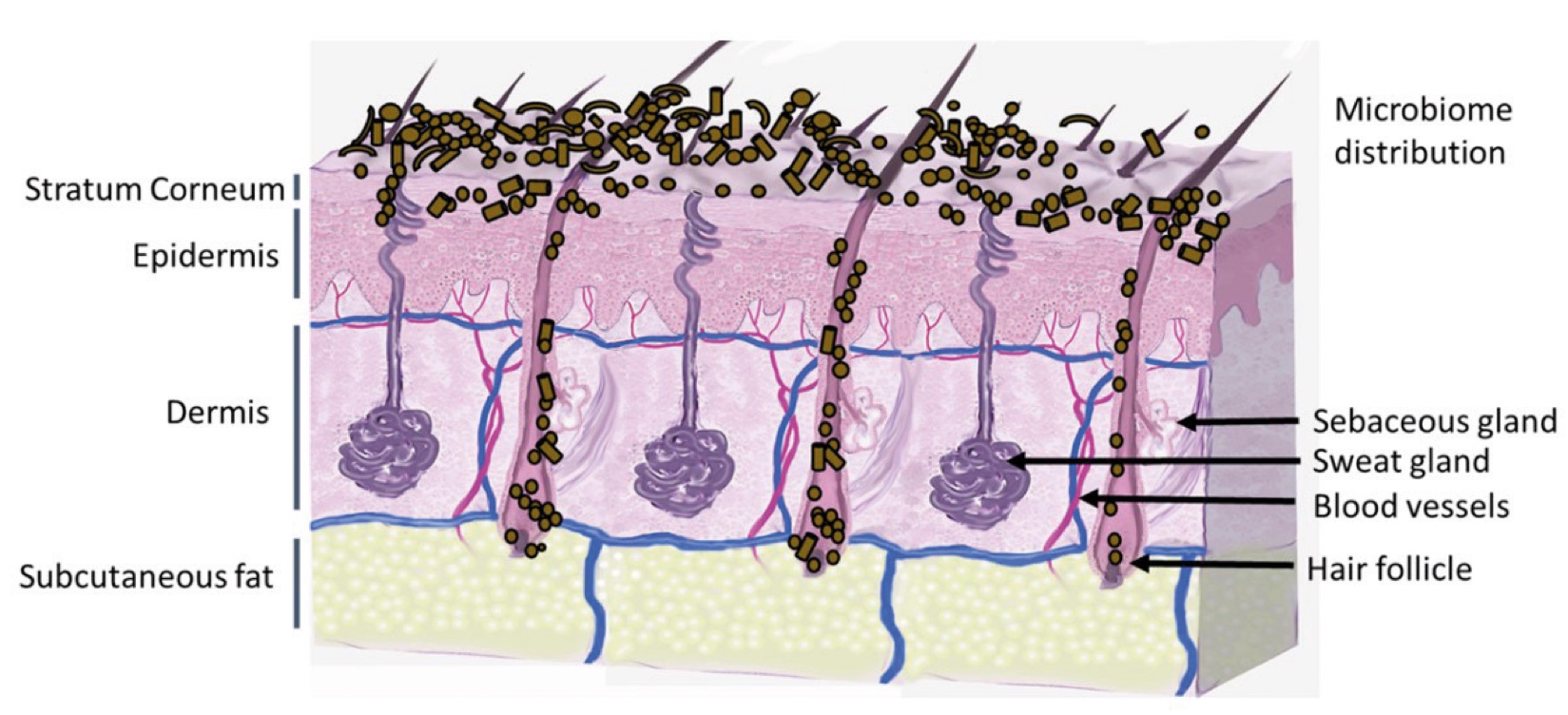
Figure 2. Skin Section with Microbiome. Most microorganisms live in the superficial layers of the stratum corneum and in the upper parts of the hair follicles. Some reside in the deeper areas of the hair follicles and are beyond the reach of ordinary disinfection procedures. There bacteria are a reservoir for recolonization after the surface bacteria are removed.
About the Authors
Jennifer Dorts holds a PhD in Biology from the University of Namur (Belgium). She has a strong scientific background in the assessment of chemical effects on aquatic organisms and extensive experience in chemical regulation. Since joining IFRA in 2020 as Scientific and Regulatory Affairs Manager, she oversees the IFRA Standards—the risk-based product stewardship framework to ensure the safe use of fragrance ingredients—and coordinates work on Natural Complex Substances (NCS) and environmental issues, while addressing complex regulatory challenges in an evolving global landscape.

Jennifer Dorts
Senior Scientific and Regulatory Affairs Manager, IFRA, Brussels, Belgium
Dr. Matthias Vey is a chemist by training from the Technical University of Darmstadt, Germany. After his studies and a short period of training as a perfumer he started in fragrance research and development for Marbert Cosmetics in Düsseldorf, Germany. He then became global regulatory affairs manager for Coty/Lancaster in Mainz, Germany. In 2000 Dr. Vey joined IFRA. In his current position as Vice President Scientific Affairs he is responsible for the fragrance industry's worldwide safe use program, known as the IFRA Standards. He also manages all of IFRA's science related committees and is strongly engaged in IFRA's advocacy activities. He is further responsible for the management of the International Dialogue on the Evaluation of Allergens (IDEA), a multi-stakeholder initiative. He regularly presents at international meetings and conferences, including the Safety Course at the free university of Brussels.
Matthias Vey
Vice President Scientific Affairs, IFRA, Brussels, Belgium
References and notes
- Api et al., Criteria for the Research Institute for Fragrance Materials, Inc. (RIFM) safety evaluation process for fragrance ingredients. Food and Chemical Toxicology (2015). 82, S1–S19. DOI: 10.1016/j.fct.2014.11.014
- Api et al., The RIFM approach to evaluating Natural Complex Substances (NCS). Food and Chemical Toxicology (2022).159, 112715. DOI: 10.1016/j.fct.2021.112715
- Lapczynski et al., Aquatic risk of fragrance materials: advancing prioritization in aquatic systems. Environmental Toxicology and Chemistry (2025). 44, 3636-3645. DOI: 10.1093/etojnl/vgaf214
- Irizar et al., Phototoxicity and skin damage: A review of adverse effects of some furocoumarins found in natural extracts. Food and Chemical Toxicology (2025). 200, 115332. DOI: 10.1016/j.fct.2025.115332
- IFRA, Quantification of Furocoumarins HPLC/DAD Procedure. 2025 ifra-analytical-method-quantitative-determination-of-furocoumarins-by-hplc-dad_revised-20250320.pdf
- Regulation - 2021/1902 - EN - EUR-Lex https://eur-lex.europa.eu/legal-content/EN/TXT/?uri=uriserv%3AOJ.L_.2021.387.01.0120.01.ENG&toc=OJ%3AL%3A2021%3A387%3ATOC.