Testing
Skin care
KEYWORDS
HAIR;
CHARACTERISATION;
SURFACE SCIENCE;
PRODUCT DEVELOPMENT
peer-reviewed
Measuring Chemical and Physical Properties of Human Hair Surfaces
Mark Cresswell
Business Manager – Formulations, Lucideon, Staffordshire, United Kingdom
ABSTRACT: The surface characterisation of hair fibres can deliver important insights into the performance of hair care products. Surface characterisation data can guide improvement to product formulations based on an understanding of the connection between product use and the resulting surface properties of the treated hair fibres. This article reviews the range of relevant hair properties together with the use of topographical and chemical surface characterisation techniques for their determination. In addition, we describe the application of chemical surface analysis techniques, including X-ray Photoelectron Spectroscopy (XPS) and Secondary Ion Mass Spectrometry (SIMS), to the determination of chemical residues and natural substrates in terms of material identification, level quantification, and spatial distribution. In all cases, practical applications are described.
??????????????????
“
“A study in healthy women providing probiotic yogurt for four weeks showed an improvement in emotional responses as measured by brain scans”

Figure 1. Skin Section with Microbiome. Most microorganisms live in the superficial layers of the stratum corneum and in the upper parts of the hair follicles. Some reside in the deeper areas of the hair follicles and are beyond the reach of ordinary disinfection procedures. There bacteria are a reservoir for recolonization after the surface bacteria are removed.
Materials and methods
Studies of major depressive disorder have been correlated with reduced Lactobacillus and Bifidobacteria and symptom severity has been correlated to changes in Firmicutes, Actinobacteria, and Bacteriodes. Gut microbiota that contain more butyrate producers have been correlated with improved quality of life (1).
A study in healthy women providing probiotic yogurt for four weeks showed an improvement in emotional responses as measured by brain scans (2). A subsequent study by Mohammadi et al. (3) investigated the impacts of probiotic yogurt and probiotic capsules over 6 weeks and found a significant improvement in depression-anxiety-stress scores in subjects taking the specific strains of probiotics contained in the yogurt or capsules. Other studies with probiotics have indicated improvements in depression scores, anxiety, postpartum depression and mood rating in an elderly population (4-7).
Other studies have indicated a benefit of probiotic supplementation in alleviating symptoms of stress. In particular, researchers have looked at stress in students as they prepared for exams, while also evaluating other health indicators such as flu and cold symptoms (1). In healthy people, there is an indication that probiotic supplementation may help to maintain memory function under conditions of acute stress.
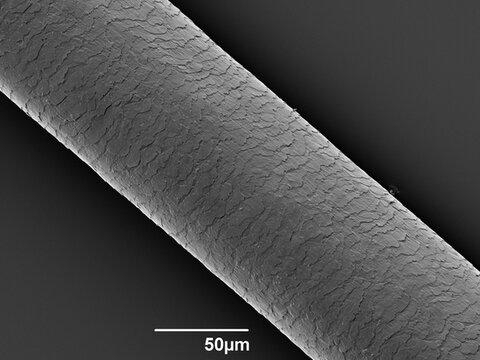
Scanning Electron Microscope (SEM) image of human hair
Valuable information obtained from the surface characterisation of hair fibres can deliver important insights into the performance of hair care products. These insights are often utilised in the development of product formulations due to a deepened understanding of the connection between product use and the resulting surface properties of the treated hair fibres.
Shampoos may contain cleansing agents (surfactants), conditioners, functional additives, preservatives, aesthetic additives, and medically active ingredients. To obtain regulatory approval, or to substantiate product claims, it is essential to be able to measure the exact effect a given product will exert on hair properties.
A vast range of relevant hair properties can be determined through topographical and chemical surface characterisation techniques. Non-contact white light interferometry (WLI) and 3D scanning electron microscopy (3D SEM) are used to investigate topographical consequences such as scale height and hair damage. These techniques provide statistically based metrology of hair surfaces either parametrically or as quantified 3D images.
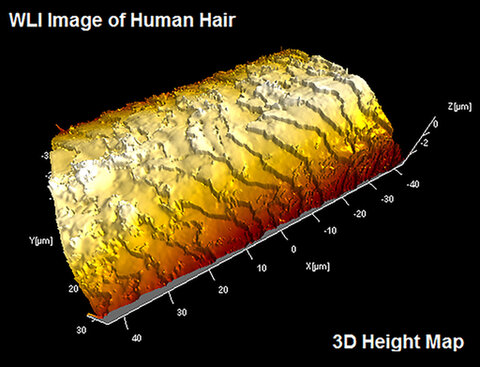
WLI image of human hair with height heat map
In addition, chemical surface analysis techniques such as X-ray Photoelectron Spectroscopy (XPS) and Secondary Ion Mass Spectrometry (SIMS) can be used to determine chemical residues and natural substrates in terms of material identification, quantification, and spatial distribution.
The development of effective hair treatments relies on detailed knowledge of hair surface chemistry and the effect of the various ingredients of the formulation on hair structure, e.g. the effect of additives on the surface lipid structure is one area of ongoing investigation.
Building a library of experience in applying these analytical techniques to product development projects allows for the translation of complex data into actionable insights for product formulators. Combining advanced surface characterisation and imaging technologies with an in-depth knowledge of consumer product performance allows surface scientists to help brands optimise the performance of their hair care products and guide the development of marketing material that can improve consumer trust.
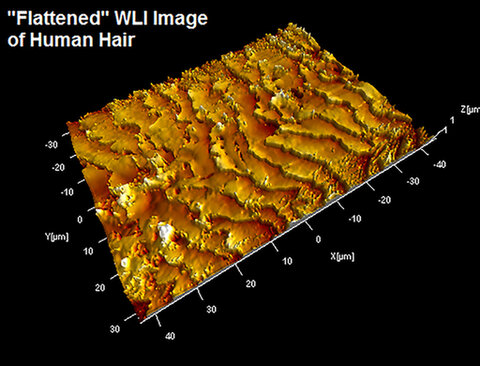
Digitally flattened WLI image of human hair with height heat map
Chemical properties of hair
The structure of hair is intimately linked to its chemistry, which imparts particular physical properties and characteristics. Hair is an outgrowth of the epidermal region of the skin, comprising the hair follicle and the hair shaft. New cells are continuously produced in the lower portion of the hair bulb and push the previously formed cells upwards. As cells reach the upper portion of the bulb, they begin to change into six cylindrical layers. Melanocytes in the hair bulb produce the melanin pigment which gives hair its colouration. The structure and chemistry of these hair features can be explored through extraction, drying, and surface analysis using SEM (Scanning Electron Microscopy) and mass spectrometry, specifically ToFSIMS (Time-of-Flight Secondary Ion Mass Spectrometry).
In the mid-follicle region, the growing cells die, harden, and form the hair, which is a mixture of hair proteins such as keratin. These proteins and protective fatty acid esters on the hair surface can be characterised analytically to monitor the effects of hair treatments and damage. The most abundant surface lipid on human hair, 18-methyl eicosanoic acid (18-MEA) can be readily detected using ToFSIMS, from which its relative surface levels can be directly related to the surface treatment(s) applied (1). 18-MEA is the only covalently bound surface lipid, the level of which is related to the gloss or sheen of hair, and its removal during, say, bleaching processes can be duly measured (2).
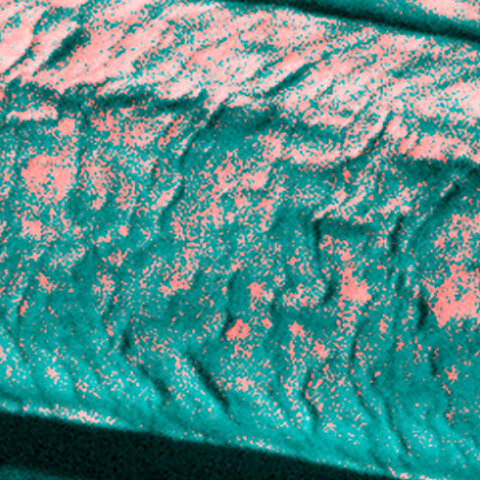
ToFSIMS image of human hair with false colour overlay of alkyl sulphate (pink) on keratin (green)
The hair shaft comprises dead cells and keratins along with binding material and small amounts of water. Terminal hairs on the scalp are lubricated by sebum from the sebaceous glands of the follicle, which can lead to greasy hair. The uptake of product ingredients from greasy hair treatments can be monitored using surface analysis techniques such as ToFSIMS and XPS.
The keratin strands in the hair cortex lie longitudinally through the length of the hair and low-sulphur keratin fibres are compressed into bundles held together by a mass of sulphur-rich keratins in a fibre matrix. The fibre matrix is strong, giving hair its physical properties. The outermost layer of the hair (the cuticle) is made up of between six and ten overlapping layers of long cells or scales. Each of these scales is around 0.3 μm thick, 100 μm in length, and 10 μm in width (3). These dimensions vary with age and ethnicity (4). The scales lie along the surface of the hair-like tiles on a roof, with their free edges directed towards the tip. Microscopy techniques such as SEM allow scale height measurements to be made in relation to the use of conditioning treatments, where a glossy appearance may be indicative of scale coverage, or to the use of curling tongs or hair straighteners, which compress the scale heights and again produce a glossy hair finish.
Surface characterisation methods for hair
3D SEM (3D scanning electron microscopy)
Available software provides the capability to convert pairs of stereoscopic digital SEM images into 3D representations of the area sampled. The resultant calibrated image contains Z (height) information, allowing metrology of macro- and micro-areas. Through this, the metrology of materials which are difficult to determine by other methods (such as rough surfaces, angular metals, cutting tools, fibres) can be easily resolved. Furthermore, compared to WLI methods, the lateral resolution in X and Y is significantly superior (5). The use of 3D SEM allows for quantification of subtle structural changes on hair. This data can be leveraged to support R&D decisions, optimise active ingredient delivery, and provide evidence for scientifically robust claims.
White Light Interferometry (WLI)
WLI is an optical metrology technique that provides measurement of the physical characteristics of a material, including micro-topography, form and texture surface topography, roughness, dimensional metrology, and layer thickness measurement. The resolution of the measurements is <1 μm in the x and y axes and <1 nm in the z-axis, allowing for micro-features and topographic variations to be monitored in detail.
Processing of the raw data allows for the generation of a range of data formats including pseudo-colour height maps, profilometry, contour map plots (axonometric plots), 3D modelling, and film thickness for sufficiently transparent layers.
WLI is ideal for characterising the effects of hair applications, such as conditioners, on the surface structure modifications achieved from their use. This data can then be correlated with qualifiable product performance metrics such as texture and reduced friction, allowing manufacturers to make rationalised and evidence-based decisions when refining product formulations.
Time-of-flight secondary ion mass spectrometry (ToF-SIMS)
In ToF-SIMS the sample surface is bombarded with a pulsed beam of primary ions. Secondary ions are sputtered from the sample surface and then mass analysed to provide detailed surface chemical information on elements, chemical groups, molecules, and polymer fragments. ToF-SIMS is analytically highly sensitive (<ppm detection levels) and although it is not directly quantitative it can provide some semi-quantitative information.
ToF-SIMS analysis provides mass spectra and chemical species spatial distribution images. The retrospective data processing capability of the instrument is particularly useful when a selected area of the sample is scanned in spectrum-per-point mode. In this mode a mass spectrum is acquired at each (μm scale) pixel point for the field of view and the resulting two-dimensional array of spectra is used to construct area specific species maps.
The versatile chemical mapping of molecular species available from the ToF-SIMS technique has been applied to the study of residual substances on the surface of human hair. These include both natural (e.g. sebum) and synthetic (e.g. hair products) materials. Human hair has a diameter of around 60 - 70 μm. The sub-micron capability of the SIMS technique generates spectacular high-resolution images showing the spatial distribution of residues with ppm sensitivity, as can be seen in figure 5 where brightness of colour indicates abundance.
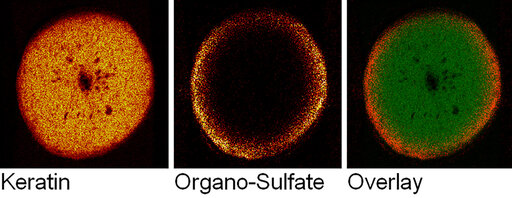
ToFSIMS image of shampoo treated / rinsed cross sectioned human hair
Product residues can be readily identified and their spatial distribution followed using this technique. This is important in hair product development, not only from an efficacy standpoint but also in terms of ensuring potential adverse effects are addressed effectively.
In one recent case, work was undertaken for a multinational manufacturer of personal care products to investigate the distribution of key surfactant ingredients following treatment of human hair with a range of formulations. Through ToF-SIMS analysis in mass spectral and imaging modes, various formulation components on the hair were identified:
- Protein, detected as CN- and CNO-, from keratin
- Silicon oil (polydimethyl-siloxane - PDMS) and quaternary ammonium compounds from conditioning agents
- Alkyl sulfates from surfactant additives
- Lipids, detected as palmitate, oleate, stearate and 18-methyleicosanoate species, from the hair structure
The ToF-SIMS analysis showed the distributions of these key species, allowing for formulation modification that optimised coverage of the surfactant and other additive species on the hair surface following washing treatment.
Conclusion
Surface chemical mapping and topographical profiling have become increasingly valuable tools in the development of hair care products, supporting areas such as formulation research, failure analysis, manufacturing investigations, and claim substantiation. Over the past few decades these techniques have enabled a deeper understanding of how treatments interact with hair at the microscopic level.
This information is often vital in matching the product formulation to the stringent requirements of regulatory authorities in major market areas such as the USA.
Conclusion
The future of cosmetics lies in the continued evolution of holistic approaches which represents a transformative shift in the industry, merging scientific advancements, natural ingredients, and wellness principles. By understanding and embracing the interconnectedness of these elements, the cosmetics industry can cultivate products that not only enhance external beauty but also contribute to the overall well-being of individuals and the planet.
The interplay between beauty from within and topical cosmetics is the key for future products. The integration of biotechnology and green chemistry is revolutionizing cosmetic formulations, offering sustainable and biocompatible alternatives.
Developers can implement blockchain to trace the journey of ingredients from source to product. Nevertheless, the efficacy of the natural products should be scientifically proven. Marketers can communicate transparency as a brand value, and parallelly educate consumers by highlighting how specific ingredients contribute to radiant and healthy skin.
By embracing the synergy between these approaches and leveraging scientific advancements, the cosmetics industry can provide consumers with comprehensive beauty solutions that cater to both internal and external dimensions of beauty.
Surfactant Applications
The application area lends itself particularly well to the use of AI. Active today in this area is the US company Potion AI (6). The company provides AI-powered formulation tools for beauty and personal care R&D. Their offerings include Potion GPT, next generation ingredient and formula databases and AI document processing. Potion’s work could have a significant impact on the entire surfactant value chain, from raw material suppliers to end consumers. By using their GPT technology, they can help target work toward novel surfactant molecules that have optimal properties for specific applications. By using their ingredient and formula databases, they can access and analyze a vast amount of data on surfactant performance, safety, and sustainability. By using their AI document processing, they can extract and organize relevant information from patents, scientific papers, and regulatory documents. These capabilities could enable Potion AI's customers to design and optimize surfactant formulations that are more effective, eco-friendly, and cost-efficient. A particularly interesting application for this type of capability is deformulation.
Deformulation is the process of reverse engineering a product's formulation by identifying and quantifying its ingredients. Deformulation can be used for various purposes, such as quality control, competitive analysis, patent infringement, or product improvement. However, deformulation can be challenging, time-consuming, and costly, as it requires sophisticated analytical techniques, expert knowledge, and access to large databases of ingredients and formulas.
AI can potentially enhance and simplify the deformulation process by using data-driven methods to infer the composition and structure of a product from its properties and performance. For example, AI can use machine learning to learn the relationships between ingredients and their effects on the product's characteristics, such as color, texture, fragrance, stability, or efficacy. AI can also use natural language processing to extract and analyze information from various sources, such as labels, patents, literature, or online reviews, to identify the possible ingredients and their concentrations in a product.
Figure 2. Skin Section with Microbiome. Most microorganisms live in the superficial layers of the stratum corneum and in the upper parts of the hair follicles. Some reside in the deeper areas of the hair follicles and are beyond the reach of ordinary disinfection procedures. There bacteria are a reservoir for recolonization after the surface bacteria are removed.
About the Author
Mark Cresswelljoined Lucideon in October 2012 and is a Chartered Chemist with a PhD from Keele University. He specialises in synthetic chemistry, materials chemistry, sol-gel chemistry, formulation science, and controlled release technologies and has been in the field for over 13 years. He is skilled in cross-sector consulting, scientific leadership, and the commercialisation of research insights, particularly in the pharmaceutical, consumer healthcare and advanced materials industries.

Mark Cresswell
Business Manager – Formulations, Lucideon, Staffordshire, United Kingdom

References and notes
- Okamoto M. The structure of the outermost hair surface and the changes due to the damage. Acc. Mater. Surf. Res. 2017, Vol.2 (No.1), 1-7. Available from: https://www.hyomen.org/wp-content/uploads/papers/vol2_no1/okamoto/okamoto_20.pdf
- Tanamachi H, Tokunaga S, Tanji N, Oguri M, Inoue S. 18‑MEA and hair appearance. J Cosmet Sci. 2010;61:147‑160. Available from: https://pubmed.ncbi.nlm.nih.gov/20447366/
- Anastassakis K. The Morphology and Structure of the Hair Shaft. In: Androgenetic Alopecia From A to Z. Springer; 2022. p. 59–76. Available from: https://link.springer.com/chapter/10.1007/978-3-030-76111-0_6
- Maymone MBC, et al. Hair Aging in Different Races and Ethnicities. The Journal of Clinical and Aesthetic Dermatology [Internet]. 2021;14(1):38. Available from: https://pmc.ncbi.nlm.nih.gov/articles/PMC7869811/
- Vipin N Tondare, John S Villarrubia, András E Vladár, Three-Dimensional (3D) Nanometrology Based on Scanning Electron Microscope (SEM) Stereophotogrammetry, Microscopy and Microanalysis, Volume 23, Issue 5, 1 October 2017, Pages 967–977, https://doi.org/10.1017/S1431927617012521