Market Trends
Skin care
KEYWORDS
Cosmetic market trends;
skin longevity; clean beauty;
sustainability; artificial intelligence.
GREEN BIOACTIVES.
peer-reviewed
Cosmetic Market Trends 2025: Innovations, Consumer Shifts and a Vision Toward 2026
Davide Musardo
Claims & Efficacy Team Lead, Biorius, Wavre, Belgium
ABSTRACT: The cosmetic market in 2025 has been characterized by significant transformations, where science-driven innovation, sustainability demands, and digital technologies converge to reshape consumer expectations and industry practices. This article provides a panoramic overview of the most relevant market trends, with a forward-looking perspective toward 2026. Particular attention is devoted to skin longevity and healthy aging, the evolution of clean beauty, and the integration of sustainable packaging solutions. The regulatory challenges associated with these shifts represent a critical undercurrent, shaping both the feasibility and credibility of innovation. The aim is to offer readers an evidence-based analysis of key directions, highlighting opportunities, risks, and compliance implications for the near future.
??????????????????
“
“A study in healthy women providing probiotic yogurt for four weeks showed an improvement in emotional responses as measured by brain scans”
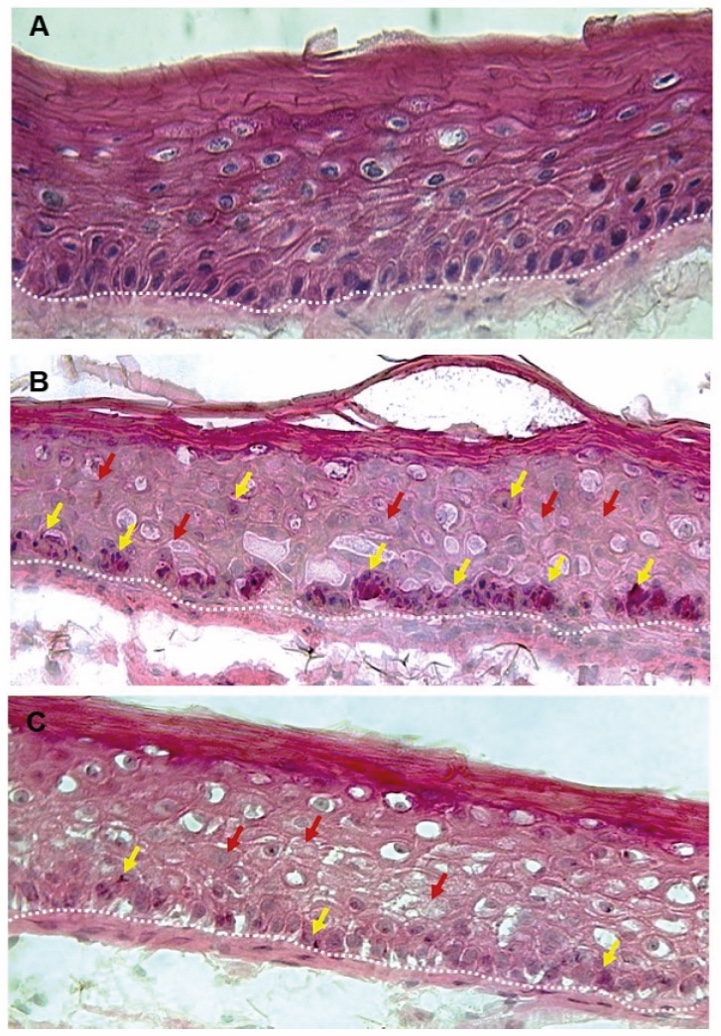
Figure 1. Skin Section with Microbiome. Most microorganisms live in the superficial layers of the stratum corneum and in the upper parts of the hair follicles. Some reside in the deeper areas of the hair follicles and are beyond the reach of ordinary disinfection procedures. There bacteria are a reservoir for recolonization after the surface bacteria are removed.
Materials and methods
Studies of major depressive disorder have been correlated with reduced Lactobacillus and Bifidobacteria and symptom severity has been correlated to changes in Firmicutes, Actinobacteria, and Bacteriodes. Gut microbiota that contain more butyrate producers have been correlated with improved quality of life (1).
A study in healthy women providing probiotic yogurt for four weeks showed an improvement in emotional responses as measured by brain scans (2). A subsequent study by Mohammadi et al. (3) investigated the impacts of probiotic yogurt and probiotic capsules over 6 weeks and found a significant improvement in depression-anxiety-stress scores in subjects taking the specific strains of probiotics contained in the yogurt or capsules. Other studies with probiotics have indicated improvements in depression scores, anxiety, postpartum depression and mood rating in an elderly population (4-7).
Other studies have indicated a benefit of probiotic supplementation in alleviating symptoms of stress. In particular, researchers have looked at stress in students as they prepared for exams, while also evaluating other health indicators such as flu and cold symptoms (1). In healthy people, there is an indication that probiotic supplementation may help to maintain memory function under conditions of acute stress.
Introduction
The global beauty and personal care market continues to expand. According to Mordor Intelligence, the sector is expected to be USD 605 billion this year and to reach 776 billion by 2030. In 2024, the Asia-Pacific region was the fastest-growing and largest market. The overall growth is sustained by strong consumer interest in products that merge well-being and AI technological innovation, sustainability and efficacy, particularly relevant for the Gen Z
(1).
Yet, alongside this growth, companies are facing increasing complexity as consumers demand more transparency, while regulators tighten requirements and technologies accelerate innovation cycles at the speed of light. The interplay of these forces is redefining the very notion of cosmetics, extending from decorative or pampering products to holistic solutions addressing health, self-expression, and ecological responsibility.
In view of these dynamics, this article provides a critical overview of the most relevant market trends in 2025, including skin longevity and healthy aging, clean beauty and transparency, packaging and sustainability, and artificial intelligence. Regulatory considerations will be interwoven throughout, as they represent a decisive factor in shaping how innovation translates into market reality.
Skin Longevity and Healthy Aging
The concept of skin longevity has rapidly replaced the outdated narrative of “anti-aging.” Rather than promising to turn back the clock, brands increasingly emphasize maintaining healthy skin function over time, focusing on resilience, prevention, and overall well-being. This semantic and conceptual evolution reflects broader societal shifts: consumers prefer positive framing and are more inclined toward strategies of proactive maintenance rather than correction (2).
From a scientific standpoint, advances in geroscience, an emerging field that seeks to understand the biological mechanisms of aging and how they contribute to age-related diseases (3), have catalysed this trend. The discovery of geroprotectors—compounds capable of extending health span and lifespan in animal models— can present promising implications for human longevity and in cosmetics, and it could lead to longevity cosmeceutical actives and products. Examples of natural-derived geroprotectors that hold greater potential for this category are Nordihydroguaiaretic acid (NDGA), Astaxanthin and Epigallocatechin gallate (EGCG) (4).
The regulatory landscape, however, introduces caution. In the EU, claims suggesting that a product could influence biological aging processes risk falling into the medicinal domain. The common criteria for the justification of claims, the related “Technical document”, underlining the importance of substantiation, and the Borderline Manual must be always considered to avoid medical connotations when communicating longevity claims. This means that while the science may be captivating, brands must carefully phrase their messaging—highlighting improved skin appearance, rather than direct intervention in biological aging.
In this sense, despite the improbability of a distinct regulatory category, developing clear guidance remains critical to support responsible innovation and protect consumers (4). The challenge for 2025–2026 will be ensuring that emerging longevity-inspired actives can be validated through robust clinical and instrumental studies, while maintaining compliance with cosmetic definitions. The aim is not to suffocate innovation but channelling it toward realistic and consumer-understandable claims.
Clean Beauty and Transparency Evolution
The clean beauty movement, once primarily defined by exclusion lists and “free-from” marketing, has evolved into a more nuanced and sophisticated paradigm. By 2025, emphasis has shifted toward transparency and scientific validation, rather than the simplistic avoidance of controversial ingredients. Consumers increasingly expect brands to substantiate their claims rigorously, both in terms of product efficacy and the sustainability impact of their formulations.
A notable evolution is the shift from the assumption that “natural = safe” toward a “science-backed clean” or “cleanical beauty” approach, where ingredient performance and measurable product outcomes are prioritized (5). This trend aligns with findings that consumers with strong environmental values are more sceptical of greenwashed claims (6) and highlights growing demand for beauty companies to deliver solutions that integrate both environmental and ethical considerations (7).
Regulatory frameworks further reinforce this trajectory. In the EU, the implementation of Directive (EU) 2024/825, which empowers consumers in the green transition (8), along with enhanced scrutiny of environmental communications, is compelling companies to provide verifiable evidence for their claims. In the United States, the Federal Trade Commission (FTC) has proposed potential updates to its Green Guides, signaling stricter monitoring of potentially misleading environmental claims (9). The convergence of consumer expectations and regulatory oversight is establishing a new benchmark for credibility in clean beauty.
Ultimately, “clean beauty” in 2025 for companies represents both an opportunity to differentiate through authenticity and a challenge to adapt communication strategies in line with evolving regulatory and consumer expectations.
Packaging and Sustainability
Packaging remains one of the most visible and contested aspects of cosmetic sustainability. In 2025, innovation is guided by two converging forces: consumer expectations for eco-friendly solutions – as shown previously - and regulatory requirements that set precise targets for recyclability and waste reduction.
The EU Packaging and Packaging Waste Regulation (PPWR) mandates a progressive transition toward reusable, recyclable, and standardized formats, with deadlines extending into 2030 but requiring preparation today (10). This regulation is not limited to cosmetics, but its impact is particularly strong in this sector given the visibility of packaging and the symbolic value consumers assign to its design and the environmental implications.
Key strategies include refillable systems, mono-material packaging designed for easier recycling, and the adoption of biodegradable or compostable alternatives. Brands also experiment with digital labelling (QR codes) to provide sustainability information (11), aligning with the broader EU’s “digital product passport” initiative under the Regulation (EU) n°2024/1781 on Eco-design (12).
However, challenges persist since refills may not always be compatible with consumer habits, biodegradable plastics may not meet durability needs, and recycling infrastructures vary significantly across markets. Therefore, sustainability in packaging is not just a matter of technological innovation but also of harmonizing claims and practices with regulatory standards, avoiding misleading messages.
Consumer Trends 2025: Insights from Zalando Beauty Brief
Insights from the Zalando 2025 Beauty in Brief report (13) highlight an evolving consumer landscape that is reshaping the cosmetic market. Emotional and functional considerations are increasingly driving purchasing decisions, with trends such as “Energy Reset” reflecting demand for products that support recovery and emotional well-being.
Simultaneously, the “Biohacking Beauty” trend underscores growing interest in biologically aligned solutions, including products designed to work with circadian rhythms or overnight, emphasizing measurable efficacy.
The report also identifies “Real-Life Beauty” as a key driver, where consumers prioritize products that perform under dynamic, everyday conditions, and “True Radiance,” reflecting heightened attention to long-term skin health, hydration, and barrier protection.
These insights underscore a broader shift toward functional, authentic, and data-driven beauty, complementing regulatory and sustainability expectations and highlighting the market’s alignment with scientific validation and transparency.
Artificial Intelligence and the Digital Beauty Revolution
These consumer preferences, emphasizing authenticity and personalization, intersect with the growing role of AI, which offers new ways to meet such demands. Artificial intelligence (AI) represents one of the most disruptive forces entering the beauty landscape. In 2025, its applications range from formulation design and trend prediction to personalized consumer experiences.
Recent developments include partnerships that make beauty products shoppable directly through AI platforms like ChatGPT integrated with Shopify, adopted by some brands (14). AI is also increasingly used by consumers to ask for real-time personalized advice, challenging traditional roles of beauty advisors and even dermatologists (15).
From a regulatory perspective, AI introduces a new dimension of risk. Data privacy and algorithm transparency become central, especially under the EU’s Artificial Intelligence Act (16) and the GDPR framework (17). On the other side, AI-generated claims and recommendations must still comply with cosmetic regulations. As noted by the UK’s Advertising Standards Authority (ASA), generating claims with AI is not an issue per se, as long as the claims do not exaggerate the product’s performance or create a misleading context, for example (18).
Nevertheless, AI holds enormous potential: in R&D, it accelerates ingredient discovery and formulation optimization; in retail, it enables unprecedented personalization (19). In the beauty sector, generative AI finds applications not only in consumer-facing functions but also as a catalyst for efficiency and innovation across the internal value chain (20).
The challenge for 2026 will be to integrate these tools responsibly, maintaining consumer trust and regulatory compliance while harnessing their transformative capacity.
Conclusion
The cosmetic market in 2025 is marked by convergence: science-driven longevity, transparency and clean formulations, sustainable packaging, consumer-driven minimalism, and the rise of artificial intelligence. Each of these dimensions offers opportunity, yet each also carries regulatory challenges that cannot be overlooked.
Far from being obstacles, these challenges represent structuring forces that direct innovation toward credible, safe, and socially responsible solutions. The transition into 2026 will likely amplify this trajectory: sustainability and AI will push the boundaries of what cosmetics can achieve, while regulators will refine frameworks to protect consumers and ensure fair competition.
Ultimately, the winners in this evolving landscape will be the companies able to combine innovation, compliance, and authenticity, delivering products that are not only thrilling for the new generation of 2026 consumers but also scientifically sound and legally sustainable.
Conclusion
The future of cosmetics lies in the continued evolution of holistic approaches which represents a transformative shift in the industry, merging scientific advancements, natural ingredients, and wellness principles. By understanding and embracing the interconnectedness of these elements, the cosmetics industry can cultivate products that not only enhance external beauty but also contribute to the overall well-being of individuals and the planet.
The interplay between beauty from within and topical cosmetics is the key for future products. The integration of biotechnology and green chemistry is revolutionizing cosmetic formulations, offering sustainable and biocompatible alternatives.
Developers can implement blockchain to trace the journey of ingredients from source to product. Nevertheless, the efficacy of the natural products should be scientifically proven. Marketers can communicate transparency as a brand value, and parallelly educate consumers by highlighting how specific ingredients contribute to radiant and healthy skin.
By embracing the synergy between these approaches and leveraging scientific advancements, the cosmetics industry can provide consumers with comprehensive beauty solutions that cater to both internal and external dimensions of beauty.
Surfactant Applications
The application area lends itself particularly well to the use of AI. Active today in this area is the US company Potion AI (6). The company provides AI-powered formulation tools for beauty and personal care R&D. Their offerings include Potion GPT, next generation ingredient and formula databases and AI document processing. Potion’s work could have a significant impact on the entire surfactant value chain, from raw material suppliers to end consumers. By using their GPT technology, they can help target work toward novel surfactant molecules that have optimal properties for specific applications. By using their ingredient and formula databases, they can access and analyze a vast amount of data on surfactant performance, safety, and sustainability. By using their AI document processing, they can extract and organize relevant information from patents, scientific papers, and regulatory documents. These capabilities could enable Potion AI's customers to design and optimize surfactant formulations that are more effective, eco-friendly, and cost-efficient. A particularly interesting application for this type of capability is deformulation.
Deformulation is the process of reverse engineering a product's formulation by identifying and quantifying its ingredients. Deformulation can be used for various purposes, such as quality control, competitive analysis, patent infringement, or product improvement. However, deformulation can be challenging, time-consuming, and costly, as it requires sophisticated analytical techniques, expert knowledge, and access to large databases of ingredients and formulas.
AI can potentially enhance and simplify the deformulation process by using data-driven methods to infer the composition and structure of a product from its properties and performance. For example, AI can use machine learning to learn the relationships between ingredients and their effects on the product's characteristics, such as color, texture, fragrance, stability, or efficacy. AI can also use natural language processing to extract and analyze information from various sources, such as labels, patents, literature, or online reviews, to identify the possible ingredients and their concentrations in a product.
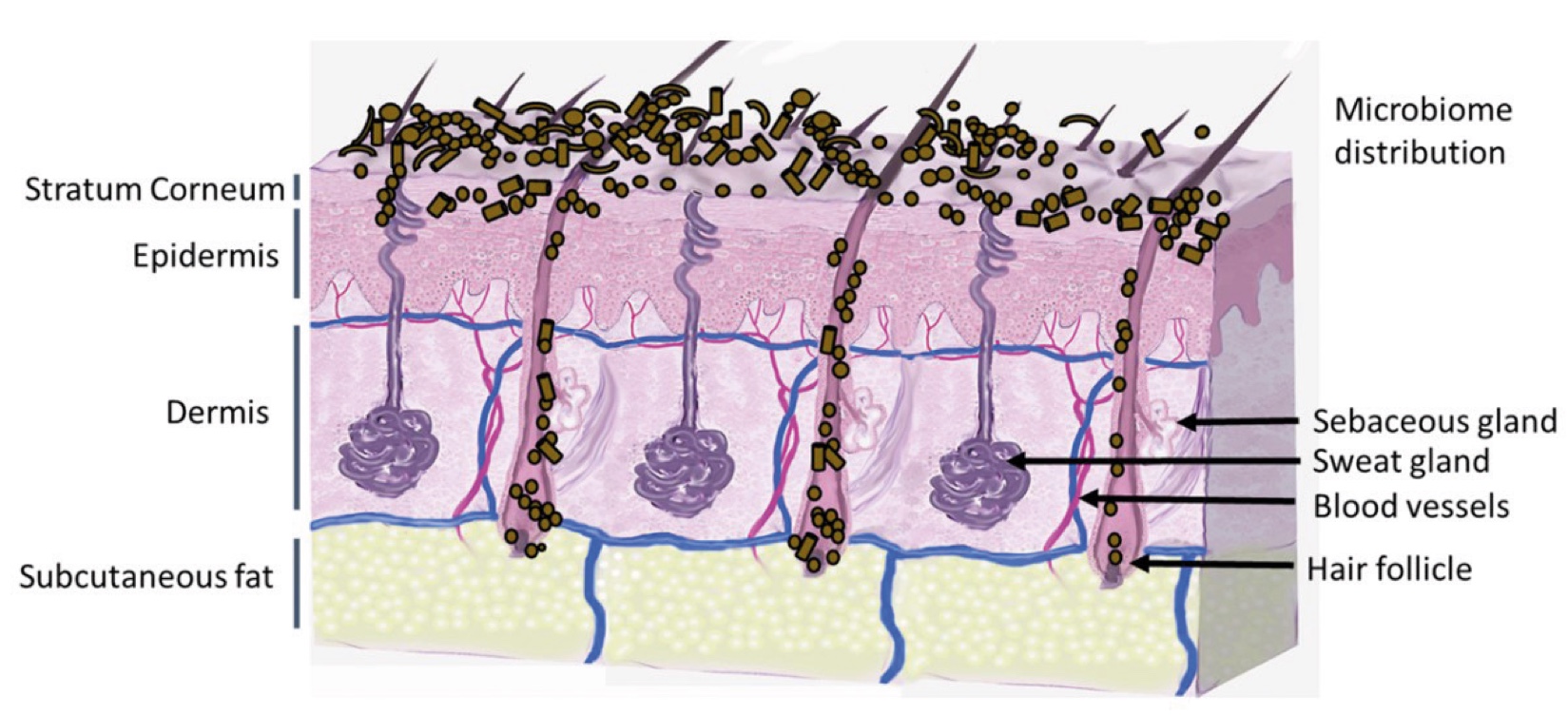
Figure 2. Skin Section with Microbiome. Most microorganisms live in the superficial layers of the stratum corneum and in the upper parts of the hair follicles. Some reside in the deeper areas of the hair follicles and are beyond the reach of ordinary disinfection procedures. There bacteria are a reservoir for recolonization after the surface bacteria are removed.
About the Author
Davide Musardo
Cosmetic science professional with years of experience in regulatory consultancy and a strong focus on claims, efficacy, and product and packaging compliance. Currently leading the Claims & Efficacy Team at Biorius, I specialize in EU/UK and international regulations, safety assessments, and scientific communication. Passionate about this exciting field, my approach combines precision and curiosity with a deep understanding of regulations to help brands navigate complicated topics, ensuring practical actions that merge clarity, confidence, and innovation.

Davide Musardo
Claims & Efficacy Team Lead, Biorius, Wavre, Belgium

References and notes
- MORDOR INTELLIGENCE. Mordor intelligence [Internet]. Mordorintelligence.com. 2015. Available from: https://www.mordorintelligence.com/industry-reports/global-beauty-and-personal-care-products-market-industry
- Dias T. Move Over Anti-Ageing, Skin Longevity is Taking Over [Internet]. Vogue Arabia. 2025. Available from: https://www.voguearabia.com/article/move-over-anti-ageing-skin-longevity-is-taking-over
- Kroemer G, Maier AB, Cuervo AM, Gladyshev VN, Ferrucci L, Gorbunova V, et al. From geroscience to precision geromedicine: Understanding and managing aging. Cell [Internet]. 2025 Apr 1;188(8):2043–62. Available from: https://www.cell.com/cell/fulltext/S0092-8674(25)00284-3
- Klinngam W, Chaiwichien A, Osotprasit S, Ruktanonchai U, Kanlayavattanakul M, Lourith N, et al. Longevity cosmeceuticals as the next frontier in cosmetic innovation: a scientific framework for substantiating product claims. Frontiers in Aging. 2025 May 22;6.
- Clean Beauty: How It’s Evolved and the Need for Regulation [Internet]. Cosmetics & Toiletries. 2024. Available from: https://www.cosmeticsandtoiletries.com/research/consumers-market/article/22910870/clean-beauty-how-its-evolved-and-the-need-for-regulation
- Sujata Khandai, Zupic I, Kohli HS, Kataria S, Yadav R, Mathew J. Greenwashing and its consequences: the role of skepticism, brand embarrassment, and brand hate in shaping purchase intentions. Quality & Quantity. 2025 Apr 4;
- Mintel. 2025 Global Beauty and Personal Care Trends [Internet]. 2025. Available from: https://www.mintel.com/insights/beauty-and-personal-care/beauty-trends/
- Directive - EU - 2024/825 - EN - EUR-Lex [Internet]. Europa.eu. 2024. Available from: https://eur-lex.europa.eu/eli/dir/2024/825/oj/eng
- Federal Trade Commission Extends Public Comment Period on Potential Updates to its Green Guides for the Use of Environmental Marketing Claims [Internet]. Federal Trade Commission. 2023. Available from: https://www.ftc.gov/news-events/news/press-releases/2023/01/federal-trade-commission-extends-public-comment-period-potential-updates-its-green-guides-use
- European Union. Regulation - EU - 2025/40 - EN - EUR-Lex [Internet]. Europa.eu. 2025. Available from: https://eur-lex.europa.eu/eli/reg/2025/40/oj/eng
- PackagingTechToday. Labeling Trends: The Crucial Role of NFC and QR Codes - Packaging Technology Today [Internet]. Packaging Technology Today. 2025. Available from: https://www.packagingtechtoday.com/materials/labels/labeling-trends-the-crucial-role-of-nfc-and-qr-codes/
- Regulation - EU - 2024/1781 - EN - EUR-Lex [Internet]. Europa.eu. 2024. Available from: https://eur-lex.europa.eu/eli/reg/2024/1781/oj/eng
- Zalando presents the 2025 Beauty in Brief report – unpacking the hottest beauty trends for summer and beyond [Internet]. Zalando Corporate Website. 2025. Available from: https://corporate.zalando.com/en/fashion/zalando-presents-2025-beauty-brief-report-hottest-beauty-trends-summer
- Glossier and Other Beauty Brands Will Soon Be Shoppable on ChatGPT Following New Shopify Partnership [Internet]. Global Cosmetic Industry. 2025. Available from: https://www.gcimagazine.com/retail/digital-e-commerce/news/22951345/glossier-and-other-beauty-brands-will-soon-be-shoppable-on-chatgpt-following-new-shopify-partnership
- ChatGPT: The New Beauty Guru? [Internet]. Global Cosmetic Industry. 2025 [cited 2025 Oct 6]. Available from: https://www.gcimagazine.com/brands-products/color-cosmetics/article/22950312/chatgpt-the-new-beauty-guru
- European Parliament. EU AI Act: First Regulation on Artificial Intelligence [Internet]. European Parliament. 2025. Available from: https://www.europarl.europa.eu/topics/en/article/20230601STO93804/eu-ai-act-first-regulation-on-artificial-intelligence
- European Union. REGULATION (EU) 2016/679 OF THE EUROPEAN PARLIAMENT AND OF THE COUNCIL [Internet]. Europa.eu. 2016. Available from: https://eur-lex.europa.eu/eli/reg/2016/679/oj/eng
- Advertising Standards Authority | Committee of Advertising Practice. “Write a useful article helping marketers with tips for using AI” [Internet]. Asa.org.uk. 2020. Available from: https://www.asa.org.uk/news/write-a-useful-article-helping-marketers-with-tips-for-using-ai.html
- Di Guardo A, Trovato F, Cantisani C, Dattola A, Nisticò SP, Pellacani G, et al. Artificial Intelligence in Cosmetic Formulation: Predictive Modeling for Safety, Tolerability, and Regulatory Perspectives. Cosmetics [Internet]. 2025 Jul 24;12(4):157.
- Checa A, Weaver K, Pacchia M, Hudson S, Liu WW. How beauty players can scale gen AI in 2025 [Internet]. McKinsey & Company. 2025. Available from: https://www.mckinsey.com/industries/consumer-packaged-goods/our-insights/how-beauty-players-can-scale-gen-ai-in-2025