
Testing
Skin care
KEYWORDS
omics; personalization;
microfluidic; neurons;
skin models; Longevity; Exposome;
Inclusivity; biometrological.
GREEN BIOACTIVES.
peer-reviewed
What are the main innovations driving the future of evaluation in the Beauty industry, insights from the 35th IFSCC Congress 2025
Anne Charpentier
Founder & Ceo, Skinobs, France
ABSTRACT: This article’s purpose is to give an overview of the drivers that will influence the innovation in the field of the evaluation whatever it is ingredients, cosmetics, nutraceuticals or medical devices. The consumer requests for science-based products will certainly impact the testing approaches of the skin, scalp and hair analysis.
Globally, the IFSCC Congress 2025 underscored a transformative era in cosmetic testing, marked by technological sophistication, inclusivity, and translational relevance. This evolution is driven by the synergistic integration of in-vitro, ex-vivo, and in-vivo models with AI-driven analytics and organ-on-chip systems, collectively enhancing the robustness, reproducibility, and consumer relevance of testing methodologies. For scientists and industry stakeholders, these advancements herald a future where cosmetic evaluation transcends conventional safety and efficacy assessments, embracing predictive precision while aligning with ethical and environmental imperatives.
??????????????????
“
“A study in healthy women providing probiotic yogurt for four weeks showed an improvement in emotional responses as measured by brain scans”
Figure 1. Skin Section with Microbiome. Most microorganisms live in the superficial layers of the stratum corneum and in the upper parts of the hair follicles. Some reside in the deeper areas of the hair follicles and are beyond the reach of ordinary disinfection procedures. There bacteria are a reservoir for recolonization after the surface bacteria are removed.
Materials and methods
Studies of major depressive disorder have been correlated with reduced Lactobacillus and Bifidobacteria and symptom severity has been correlated to changes in Firmicutes, Actinobacteria, and Bacteriodes. Gut microbiota that contain more butyrate producers have been correlated with improved quality of life (1).
A study in healthy women providing probiotic yogurt for four weeks showed an improvement in emotional responses as measured by brain scans (2). A subsequent study by Mohammadi et al. (3) investigated the impacts of probiotic yogurt and probiotic capsules over 6 weeks and found a significant improvement in depression-anxiety-stress scores in subjects taking the specific strains of probiotics contained in the yogurt or capsules. Other studies with probiotics have indicated improvements in depression scores, anxiety, postpartum depression and mood rating in an elderly population (4-7).
Other studies have indicated a benefit of probiotic supplementation in alleviating symptoms of stress. In particular, researchers have looked at stress in students as they prepared for exams, while also evaluating other health indicators such as flu and cold symptoms (1). In healthy people, there is an indication that probiotic supplementation may help to maintain memory function under conditions of acute stress.
The 35th IFSCC Congress, held in Cannes in September 2025 showcased groundbreaking advancements and emerging trends in cosmetic testing and evaluation. This keynote article synthesizes the key themes, innovations, and societal shifts influencing the future of cosmetic science, with a focus on sustainability, personalization, neuroscience, and technological integration.
The cosmetic industry is undergoing a paradigm shift, driven by scientific advancements, regulatory changes, and evolving consumer expectations. The 35th IFSCC Congress highlighted the importance of holistic skin health, personalized diagnostics, and sustainable innovation. Among the 68 podium conferences and the 730 posters, this article explores the dominant trends and the low signals observed during the congress, emphasizing their implications for research, development, and testing strategies.
Across podium presentations and 300 posters devoted to testing, recurrent themes included photoprotection, neuroscience, exposome-related research, microbiome investigations, and “well-aging” strategies. Longevity, sustainability, pigmentation, and neurosensory approaches were also central. The predominance of studies on “Longevity” and the microbiome reflects a transition from short-term anti-aging claims to holistic strategies that emphasize resilience, regeneration, and microbial balance.
Dominant Testing Topics & innovations
The IFSCC Congress 2025 underscores a pivotal evolution in cosmetic science, particularly in the methodologies of product testing. The congress highlighted the convergence of in-vitro, ex-vivo, and in-vivo approaches, showcasing the integration of sophisticated scientific tools with a clear focus on consumer-relevant outcomes.
Longevity and Multifactorial Skin Aging
A central focus of recent research has been the intersection of longevity and the multifactorial processes underlying skin aging, transcending traditional anti-aging paradigms. Contemporary approaches prioritize skin regeneration, resilience, and repair, aligning with the broader concept of "well-aging." Key mechanisms underpinning skin aging include inflammaging, oxidative stress, glycation, and microbiome interactions, all of which are influenced by both intrinsic biological clocks and extrinsic factors such as the exposome, pollution, and UV-induced damage.
The integration of biomarkers and omics technologies, encompassing genomics, proteomics, and metabolomics, has emerged as a pivotal strategy for assessing long-term skin health. These tools enable a more precise evaluation of aging processes, facilitating the development of targeted interventions that address the complex interplay between environmental exposures and biological aging pathways.
Sensitive Skin, Stress Pathways, and the Skin-Exposome
Recent advancements have positioned sensitive skin as a critical area of dermatological research, with stress identified as a primary exacerbating factor. Investigations into neurosensory pathways and the skin-brain axis have yielded novel biomarkers and mechanistic understandings of cutaneous reactivity, elucidating how psychological and physiological stressors modulate skin barrier function and inflammatory responses.
Concurrently, the impact of environmental stressors, particularly pollution and UV exposure, has garnered heightened attention, driven by evolving regulatory standards and growing concerns over the exposome’s role in skin health. Research on the skin microbiome has further underscored its pivotal role in maintaining microbial equilibrium, influencing conditions such as acne, aging, and UV-induced damage. These findings not only highlight the microbiome’s contribution to skin resilience but also provide measurable parameters for assessing product efficacy and therapeutic interventions.
This integrated perspective bridges neuroimmunological mechanisms with environmental and microbial determinants, offering a holistic framework for addressing sensitive skin and its multifaceted etiologies.
Advanced Methodologies: In-vitro and Ex-vivo Models
The congress placed strong emphasis on sophisticated model systems. Developments included vascularized and neuronal co-cultures, microfluidic technologies, transcriptomics, and dermal-epidermal junction reconstructions. Organ-on-chip models demonstrated dynamic responses in cell shape and movement, offering unprecedented physiological relevance. Multi-omics and biomarker-based approaches now enable molecularly precise assessment of product effects.
In-vivo Evaluation: Inclusivity and Holistic Metrics
In-vivo testing expanded its scope, integrating holistic and inclusive approaches. Particular focus was given to diverse populations, including Asian cohorts, underscoring the global relevance of testing protocols. Emerging methods incorporated multimodal instrumental measurements, gravitational force analyses for sagging, and objective quantification of tone, wrinkles, translucency, and blemishes. The rise of “holistic” and “well-aging” paradigms reflects a transition from traditional anti-aging claims towards more comprehensive skin health perspectives.
The Convergence of AI, Advanced Diagnostics, and Hyper-Personalization
The integration of AI-driven diagnostics, 3D imaging, and microbiome profiling is fundamentally transforming the landscape of personalized skincare. Recent advancements emphasize the seamless fusion of consumer data with predictive algorithms, enabling the development of tailored formulations that address individual skin needs with unprecedented precision. This paradigm shift extends to neuroscience-based predictions, where hyper-personalization is achieved by anticipating both physiological and emotional responses to skincare interventions.
Moreover, in-silico modeling and AI-driven analytics are redefining the evaluation of efficacy, safety, and regulatory compliance, particularly in the context of complex and diverse ingredient combinations. These technologies facilitate rapid, data-driven assessments, ensuring both innovation and adherence to stringent standards.
Complementing these advancements, AI and advanced imaging modalities, including video-based and multimodal techniques, have emerged as indispensable tools in dermatological research and product development. These methodologies enable the quantification of subtle skin changes, as well as the assessment of emotional and neurosensory responses, thereby bridging the gap between scientific validation and consumer trust. By providing objective, measurable insights, these technologies enhance transparency and efficacy, reinforcing the credibility of personalized skincare solutions.
Emerging Trends in Cosmetic Testing & Technological Inspirations
The IFSCC Congress 2025 provided not only a panorama of dominant testing paradigms but also an insightful glance at “low signals”—emerging trends that may shape the future of cosmetic evaluation. These underexplored themes illuminate the expanding boundaries of scientific inquiry and the ethical, technological, and environmental imperatives reshaping the discipline.
Skin Energy, Biofunctional Approaches & Fascia
Among the most forward-looking concepts was the notion of “skin energy,” an under-investigated domain proposing the assessment of bioenergetics as a measurable parameter for cutaneous vitality. Although scarcely addressed, its inclusion suggests a potential paradigm for redefining skin health beyond structural or biochemical markers. Meanwhile, fascia research emerges as a novel frontier, potentially bridging biomechanics, skin support, and aesthetic outcomes. These understudied domains demand further exploration for mechanistic clarity and claim substantiation.
Eco-Sustainability and Environmental Safety
Echoing global ecological concerns, eco-sustainability emerged as a nascent but pivotal theme. Presentations emphasized non-penetrating, biodegradable, and reef-safe systems, particularly in relation to sunscreen formulations. While currently underrepresented, these approaches reflect the necessity of aligning product efficacy with environmental stewardship, anticipating future regulatory frameworks and consumer expectations.
Slow Aging and Hyper-Personalization
The congress also highlighted “slow aging” as a distinct research trajectory, shifting from anti-aging claims to concepts of long-term maintenance and resilience. Coupled with this was the expansion of hyper-personalized cosmetics, integrating diagnostic tools and formulation architecture to anticipate regulatory, safety, and efficacy constraints across innumerable ingredient combinations. This methodological rigor, though still in early development, signals a transformative trend toward tailoring cosmetic solutions with unprecedented precision.
Conversational Avatars and Ethical Interfaces
Another striking theme was the incorporation of digital and ethical dimensions into cosmetic evaluation. “Conversational avatars” were presented as future tools for consumer interaction, bridging dermatological science and digital health. Alongside this, ethical considerations—ranging from data transparency to inclusivity—were underscored, though practical methodologies remain undefined.
Multi-Pathway Networks and Systemic Approaches
Future testing paradigms are expected to move beyond single-target mechanisms. The introduction of multi-pathway networks signals a systemic approach, integrating signaling cascades and biomolecular crosstalk to better capture the multifactorial nature of skin responses. This vision aligns with the growing emphasis on systems biology and multi-omics in cosmetic evaluation.
Climatic Adaptation & Full-Spectrum Photoprotection
Incorporating local climatic conditions into testing protocols highlights the environmental contextualization of product efficacy and tolerance, challenging standardized frameworks. Concurrently, full-spectrum photoprotection, addressing UV, visible, and infrared exposures, expands protective strategies. The integration of local climatic conditions into cosmetic testing underscores the necessity of environmentally contextualized protocols, as product efficacy and tolerance are inherently influenced by regional variables. This adaptation challenges conventional standardized frameworks, advocating for globally relevant evaluations. Simultaneously, full-spectrum photoprotection, encompassing UV, visible light, and infrared radiation, redefines sun-care strategies, addressing broader spectral threats.
Space Exploration as an Experimental Horizon
Finally, the congress intriguingly positioned space exploration as a futuristic lens for cosmetic testing. Microgravity and radiation exposure were discussed as extreme models to interrogate skin physiology, resilience, and product performance. While speculative, such frameworks may catalyze novel insights into aging, repair, and adaptation.
In conclusion, the low-signal discussions at IFSCC 2025, illuminate critical trajectories for the future of cosmetic science. From eco-sustainability and bioenergetics to fascia research and space-based testing, these emerging domains expand both the methodological and philosophical boundaries of cosmetic evaluation. For scientists and industry stakeholders, they represent not only speculative curiosities but also potential future standards. Their present marginality underscores the need for further validation, cross-disciplinary engagement, and methodological rigor. Yet their very presence in the congress discourse signals that cosmetic science is preparing to embrace new horizons where ethics, sustainability, and systemic approaches converge.

In conclusion, the low-signal discussions at IFSCC 2025, illuminate critical trajectories for the future of cosmetic science. From eco-sustainability and bioenergetics to fascia research and space-based testing, these emerging domains expand both the methodological and philosophical boundaries of cosmetic evaluation. For scientists and industry stakeholders, they represent not only speculative curiosities but also potential future standards. Their present marginality underscores the need for further validation, cross-disciplinary engagement, and methodological rigor. Yet their very presence in the congress discourse signals that cosmetic science is preparing to embrace new horizons where ethics, sustainability, and systemic approaches converge.
Globally, the IFSCC Congress 2025 underscored a transformative era in cosmetic testing, marked by technological sophistication, inclusivity, and translational relevance. This evolution is driven by the synergistic integration of in-vitro, ex-vivo, and in-vivo models with AI-driven analytics and organ-on-chip systems, collectively enhancing the robustness, reproducibility, and consumer relevance of testing methodologies. For scientists and industry stakeholders, these advancements herald a future where cosmetic evaluation transcends conventional safety and efficacy assessments, embracing predictive precision while aligning with ethical and environmental imperatives.
The Congress demonstrated that cosmetic testing is evolving into a multidimensional science, where in-silico predictions, AI, and holistic in-vivo studies converge to establish inclusive, accurate, and sustainable standards. This shift not only elevates the scientific credibility of the industry but also addresses consumer demands for performance, personalization, and sustainability.
This synthesis confirms that the future of cosmetic testing lies at the intersection of scientific rigor, technological innovation, and societal relevance, positioning evaluation as both a driver of product development and a guarantor of consumer trust.
Conclusion
The future of cosmetics lies in the continued evolution of holistic approaches which represents a transformative shift in the industry, merging scientific advancements, natural ingredients, and wellness principles. By understanding and embracing the interconnectedness of these elements, the cosmetics industry can cultivate products that not only enhance external beauty but also contribute to the overall well-being of individuals and the planet.
The interplay between beauty from within and topical cosmetics is the key for future products. The integration of biotechnology and green chemistry is revolutionizing cosmetic formulations, offering sustainable and biocompatible alternatives.
Developers can implement blockchain to trace the journey of ingredients from source to product. Nevertheless, the efficacy of the natural products should be scientifically proven. Marketers can communicate transparency as a brand value, and parallelly educate consumers by highlighting how specific ingredients contribute to radiant and healthy skin.
By embracing the synergy between these approaches and leveraging scientific advancements, the cosmetics industry can provide consumers with comprehensive beauty solutions that cater to both internal and external dimensions of beauty.
Surfactant Applications
The application area lends itself particularly well to the use of AI. Active today in this area is the US company Potion AI (6). The company provides AI-powered formulation tools for beauty and personal care R&D. Their offerings include Potion GPT, next generation ingredient and formula databases and AI document processing. Potion’s work could have a significant impact on the entire surfactant value chain, from raw material suppliers to end consumers. By using their GPT technology, they can help target work toward novel surfactant molecules that have optimal properties for specific applications. By using their ingredient and formula databases, they can access and analyze a vast amount of data on surfactant performance, safety, and sustainability. By using their AI document processing, they can extract and organize relevant information from patents, scientific papers, and regulatory documents. These capabilities could enable Potion AI's customers to design and optimize surfactant formulations that are more effective, eco-friendly, and cost-efficient. A particularly interesting application for this type of capability is deformulation.
Deformulation is the process of reverse engineering a product's formulation by identifying and quantifying its ingredients. Deformulation can be used for various purposes, such as quality control, competitive analysis, patent infringement, or product improvement. However, deformulation can be challenging, time-consuming, and costly, as it requires sophisticated analytical techniques, expert knowledge, and access to large databases of ingredients and formulas.
AI can potentially enhance and simplify the deformulation process by using data-driven methods to infer the composition and structure of a product from its properties and performance. For example, AI can use machine learning to learn the relationships between ingredients and their effects on the product's characteristics, such as color, texture, fragrance, stability, or efficacy. AI can also use natural language processing to extract and analyze information from various sources, such as labels, patents, literature, or online reviews, to identify the possible ingredients and their concentrations in a product.
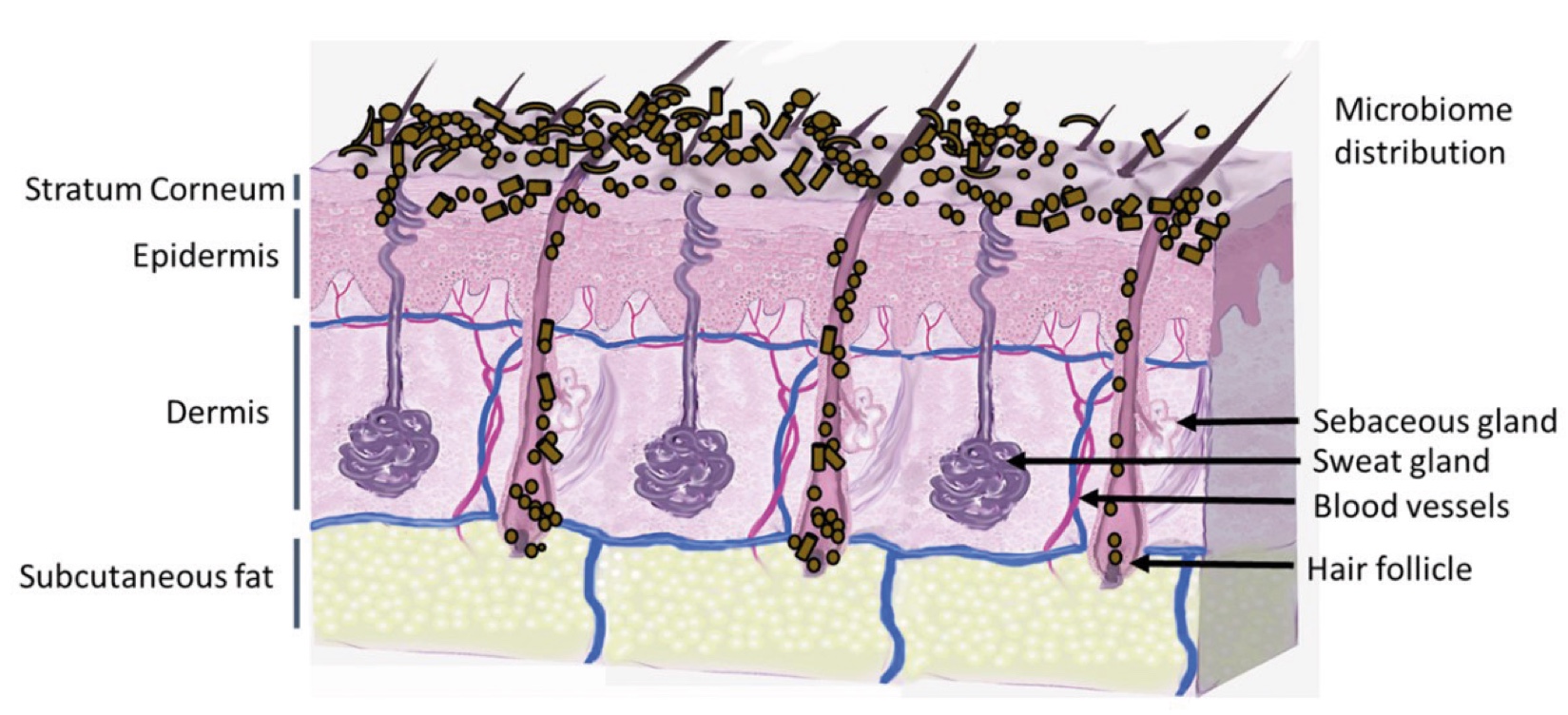
Figure 2. Skin Section with Microbiome. Most microorganisms live in the superficial layers of the stratum corneum and in the upper parts of the hair follicles. Some reside in the deeper areas of the hair follicles and are beyond the reach of ordinary disinfection procedures. There bacteria are a reservoir for recolonization after the surface bacteria are removed.
About the Author
Anne Charpentier is the founder and ceo of Skinobs, a unique and worldwide platform for both Clinical & Preclinical testing and a Cosmetics Testing News dedicated to the evaluation field for ingredients and cosmetics. She has over 30-year experience in the cosmetics testing industry. She is the president of the scientific committee of the Cosmetotest Symposium, dedicated to the field of evaluation in Beauty and member of the board of the scientific association Cosmet’in Lyon.

Anne Charpentier
Founder & Ceo, Skinobs, France

References and notes
- Kitzmiller C. Beauty Lifestages – Mature Beauty – US – 2023. Mintel. 31 décembre 2023.
- López-Otín C, et al. Hallmarks of aging: An expanding universe. Cell. 2023;186(2):243-278.
- Zhang ZG, Bothe I, Hirche F, Zweers M, Gullberg D. Interactions of primary fibroblasts and keratinocytes with extracellular matrix proteins: contribution of alpha2beta1 integrin. J Cell Sci. 2006;119(9):1886-95.
- Ellert-Miklaszewska A, Poleszak K, Pasierbinska M, Kaminska B. Integrin Signaling in Glioma Pathogenesis: From Biology to Therapy. Int J Mol Sci. 2020;21(3):888.
- Lovell CR, Smolenski KA, Duance VC, Light ND, Young S, et al. Type I and III collagen content and fibre distribution in normal human skin during ageing. Br J Dermatol. 1987;117(4):419-28.
- Sheetz MP, Felsenfeld DP, Galbraith CG. Cell migration: regulation of force on extracellular-matrix-integrin complexes. Trends Cell Biol. 1998;8(2):51-4.
- Vogel V, Sheetz M. Local force and geometry sensing regulate cell functions. Nat Rev Mol Cell Biol. 2006;7(4):265-75.
- Coutts L, Bamber J, Miller N. Multi-directional in vivo tensile skin stiffness measurement for the design of a reproducible tensile strain elastography protocol. Skin Res Technol. 2013;19(1):e37-44.
- Pellegrin S, Mellor H. Actin stress fibres. J Cell Sci. 2007;120(20):3491-9.
- Giangreco A, Goldie SJ, Failla V, Saintigny G, Watt FM. Human skin aging is associated with reduced expression of the stem cell markers beta1 integrin and MCSP. J Invest Dermatol. 2010;130(2):604-8.
- Liu S, et al. Expression of integrin beta1 by fibroblasts is required for tissue repair in vivo. J Cell Sci. 2010; 123(21):3674-82.
- Vázquez F, Palacios S, Alemañ N, Guerrero F. Changes of the basement membrane and type IV collagen in human skin during aging. Maturitas. 1996;25(3):209-15.
- Langton AK, Halai P, Griffiths CE, Sherratt MJ, Watson RE. The impact of intrinsic ageing on the protein composition of the dermal-epidermal junction. Mech Ageing Dev. 2016;156:14-6.
- Feru J, Delobbe E, Ramont L, Brassart B, Terryn C, et al. Aging decreases collagen IV expression in vivo in the dermo-epidermal junction and in vitro in dermal fibroblasts: possible involvement of TGF-β1. Eur J Dermatol. 2016;26(4):350-60.
- Ezure T, Amano S. Influence of subcutaneous adipose tissue mass on dermal elasticity and sagging severity in lower cheek. Skin Res Technol. 2010;16(3):332-8.
- Ezure T, Amano S. Involvement of upper cheek sagging in nasolabial fold formation. Skin Res Technol. 2012;18(3):259-64.
- Kruglikov IL, Scherer PE. Skin aging: are adipocytes the next target? Aging (Albany NY). 2016;8(7):1457-69.