
ADVERTORIAL

Active Energy:
The key ingredient for energizing
body care products
Active Energy, composed of Damiana, Cocoa and Passion flower extracts, is recommended for energizing and shaping bodycare formulations. This combination of natural extracts is designed to enhance skin vitality and promote a more sculpted appearance.
Stressful life, fatigue and tirdeness are the main factors that contribute to get lower our energy levels.
These conditions could alterate skin barrier and improve the formation of free radicals, the main cause of oxidative stress and premature aging.
To prevent and contrast this phoenomenons we have combined natural extracts mentioned above, that synergically interact to contrast the overtime effects.
The main properties of natural extracts contained into ACTIVE ENERGY represent a great ally against environmental factors.
Cocoa seeds (1), widely used for its antioxidant, anti-aging andenergizing abilities due to its caffeine content, stimulate circulation and contribute to decrease and contrast cellulite and skin imperfection caused by lipidic accumulation.
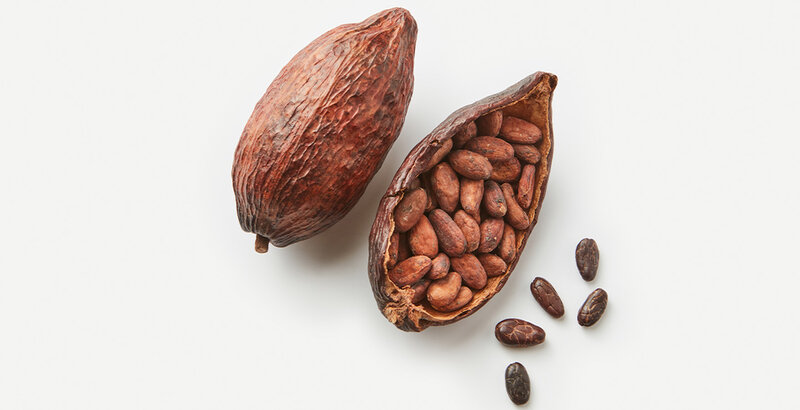
Cocoa seeds
Damiana (Turnera diffusa extract) (2), (3) is an Aromatic bush native of tropical America, that has antioxidant and stimulating properties, that prevents premature aging and signs of aging.

Passiflora (4) is rich in flavonoids compounds that have a skin-protective and depigmenting activities, highlighting their potential inclusion in cosmetic formulations.

METHODS
The HepG2 hepatoma-derived cell line (ATCC HB-8065) was cultured in Dulbecco's Modified Eagle Medium (DMEM) supplemented with 10% fetal bovine serum (FBS) and maintained at 37°C in a humidified atmosphere with 5% CO₂. To induce lipid overload, HepG2 cells were grown to approximately 75% confluence before being exposed to a fatty acid mixture consisting of oleic acid and palmitic acid at a 2:1 molar ratio. The final concentration of the fatty acid mixture was 0.6 mM, and cells were incubated under these conditions for 24 hours.
When assessing the effects of the ACTIVE ENERGY, a 0.5% concentration was added to the culture medium simultaneously with the fatty acid mixture.
Preparation of the fatty acid stock solutions involved dissolving 100 mM of palmitic acid and oleic acid in dimethyl sulfoxide (DMSO). A 10% (w/v) fatty acid-free bovine serum albumin (BSA) solution was prepared in Milli-Q water. A working solution of 5 mM fatty acid bound to 1% BSA was obtained by adding the appropriate volumes of oleate and palmitate stock solutions to the 10% BSA solution and incubating at 55°C for 30 minutes.
All solutions were sterilized via filtration before use. Cell viability prior to seeding was assessed using the trypan blue exclusion assay to ensure reproducibility and optimal cell conditions in all experiments.
Determination of Intracellular Lipid Content by Confocal Microscopy
Intracellular lipid content was quantified using Nile red staining. HepG2 cells (250,000) were seeded in a six-well microplate and subjected to fatty acid treatment for 24 hours. Following treatment, cells were washed, permeabilized, and fixed under sterile conditions. Lipids were stained with Nile red (0.5 μg/mL), a fluorescent dye with solvatochromic properties, allowing dual emission spectra to distinguish neutral and polar lipids. Fluorescence was captured using an LSM 800 confocal microscope equipped with a 40×/1.3 objective lens, with excitation/emission wavelengths of 495/519 nm and 594/618 nm. All staining procedures were conducted at room temperature, with samples shielded from direct light to prevent photobleaching.
RESULTS
To evaluate the effect of ACTIVE ENERGY on human cells, an in vitro model was established. This model replicated hyperlipidemic conditions by exposing HepG2 cells to a 2:1 molar ratio of oleate and palmitate, bound to 1% BSA, yielding a 6:1 fatty acid-to-BSA molar ratio. While fatty acid exposure at a concentration of 0.6 mM for 24 hours led to significant intracellular lipid accumulation, cell exposure to ACTIVE ENERGY importantly decrease the presence of lipid droplets in the cell cytoplasm.
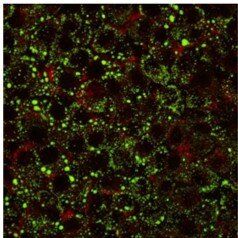
Confocal microscopy confirmed an increase in cytoplasmic lipid droplets in response to fatty acid treatment (figure 1A).
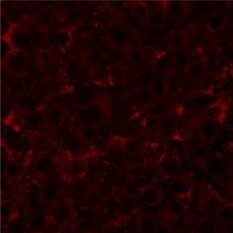
At a concentration of 0.6 mM, lipid droplet internalization was already evident, with a greater abundance compared to control cultures (figure 1B).
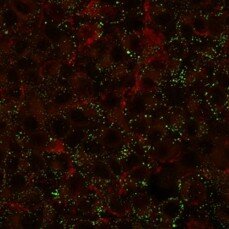
Notably, when 0.5% ACTIVE ENERGY was added to the culture medium, a marked reduction in intracellular lipid content was observed (figure 1C), with levels approaching those seen in untreated control cells.
These findings show that when 0.5% ACTIVE ENERGY is incorporated in the cell culture media, it can be observed a decrease in cell lipid content (figure 1C), close to the observation found in control cell cultures. In order to continue understanding this effect linked to an increased cell catabolism, further studies are being performed.
A growing body of evidence reports the ability of polyphenols to perform several important biological activities in addition to their antioxidant activity. Special attention has been given to the ability of polyphenols to modulate mitochondrial processes. Thus, polyphenols, as the ones found in ACTIVE ENERGY, are now recognized as molecules capable of modulating pathways that regulate cell catabolism, mitochondrial function, and thermogenesis as an example of the energizing activity of cells.

CONCLUSIONS
Combining together properties of natural extracts such as damiana antioxidant activity, cocoa seed extract stimulating action and passion flower extracts soothing properties, increase energy expenditure levels through thermogenic activity activation because of the combining actions of poliphenols.
In light of this new evidences, ACTIVE ENERGY represent a new, great ally to formulate green-based cosmetics maximizing the powerful properties of natural ingredients respecting skin barrier.
References and notes
- Agudelo, C.; Bravo, K.; Ramírez-Atehortúa, A.; Torres, D.; Carrillo-Hormaza, L.; Osorio, E. Chemical and Skincare Property Characterization of the Main Cocoa Byproducts: Extraction Optimization by RSM Approach for Development of Sustainable Ingredients. Molecules2021, 26, 7429. https://doi.org/ 10.3390/molecules26247429
- Kim, M.; Ha, L.-K.; Oh, S.; Fang, M.; Zheng, S.; Bellere, A.D.; Jeong, J.; Yi, T.-H. Antiphotoaging Effects of Damiana (Turnera diffusa) Leaves Extract via Regulation AP-1 and Nrf2/ARE Signaling Pathways. Plants2022, 11, 1486. https:// doi.org/10.3390/plants11111486
- Lluvia de Abril Alexandra Soriano-Melgar , Lilia Alcaraz-Meléndez , Lía C. Méndez-Rodríguez , María Esther Puente , Andrés Eduardo Estrada-Castillón , Fernando Rivera-Cabrera , Tania Zenteno-Savín. Effect of environmental conditions on the antioxidant content of damiana (Turnera diffusa Willd). Wulfenia · October 2014 Vol 21, No. 10
- Pardo Solórzano, M.V.; Costa, G.M.; Castellanos, L. Passiflora By-Products: Chemical Profile and Potential Use as Cosmetic Ingredients. Sci. Pharm. 2024, 92, 57. https:// doi.org/10.3390/scipharm92040057
Esperis
SARAH PIZZOLATO1, CHIARA INVERNIZZI2
1. Quality Assurance & Regulatory Affairs Manager
2. Lab Assistant
www.esperis.it
info@esperis.it


Figure 1a.
Figure 1b.
Figure 1c.
The CosmeticLAB in a nutshell
The CosmeticLAB of Mérieux NutriSciences, a pivotal branch of the global Mérieux NutriSciences Corporation, excels in the cosmetic sector with a commitment to ensuring product efficacy, safety and quality. Leveraging state-of-the-art technology and stringent testing methodologies, we offer comprehensive services, including chemical, microbiological, and efficacy evaluations. Our expertise also extends to sensory and consumer studies, ensuring that cosmetics meet both industry standards and end users expectations. As pioneers in cosmetic testing, we are dedicated to innovation, sustainability, and client-focused solutions. This commitment is encapsulated in “Our science, your beauty”, reflecting our dedication to enhancing beauty through scientific excellence.