Considerations on the biosurfactants realities: let’s call a spade a spade
GUIDO BOGNOLO
Independent consultant, Belgium
??????????????????
“
“A study in healthy women providing probiotic yogurt for four weeks showed an improvement in emotional responses as measured by brain scans”
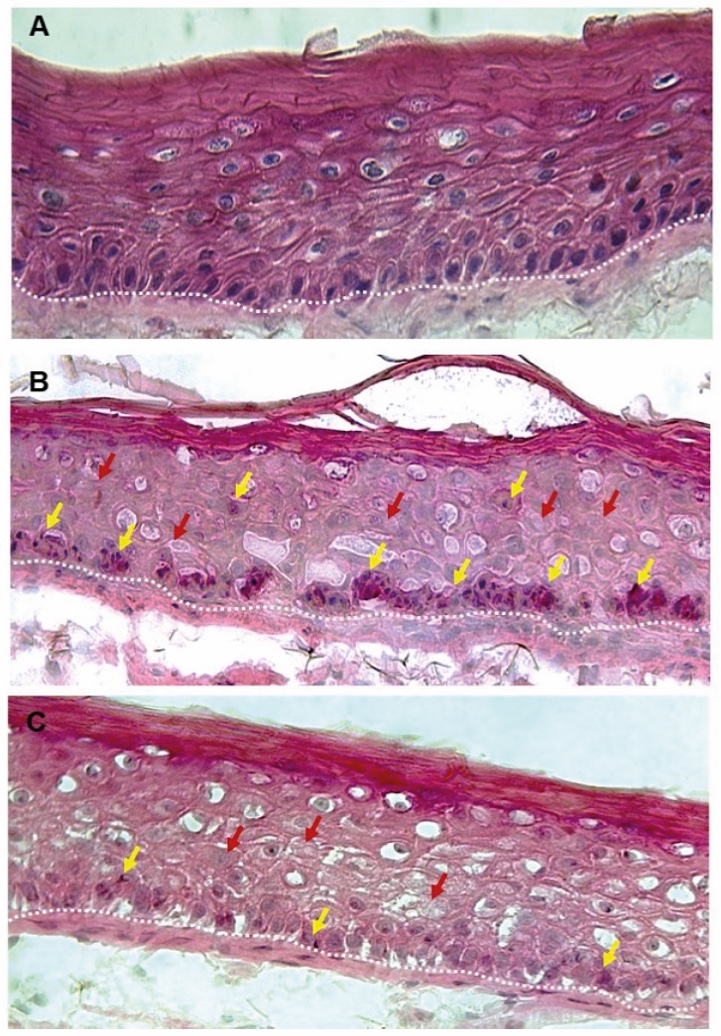
Figure 1. Skin Section with Microbiome. Most microorganisms live in the superficial layers of the stratum corneum and in the upper parts of the hair follicles. Some reside in the deeper areas of the hair follicles and are beyond the reach of ordinary disinfection procedures. There bacteria are a reservoir for recolonization after the surface bacteria are removed.
Materials and methods
Studies of major depressive disorder have been correlated with reduced Lactobacillus and Bifidobacteria and symptom severity has been correlated to changes in Firmicutes, Actinobacteria, and Bacteriodes. Gut microbiota that contain more butyrate producers have been correlated with improved quality of life (1).
A study in healthy women providing probiotic yogurt for four weeks showed an improvement in emotional responses as measured by brain scans (2). A subsequent study by Mohammadi et al. (3) investigated the impacts of probiotic yogurt and probiotic capsules over 6 weeks and found a significant improvement in depression-anxiety-stress scores in subjects taking the specific strains of probiotics contained in the yogurt or capsules. Other studies with probiotics have indicated improvements in depression scores, anxiety, postpartum depression and mood rating in an elderly population (4-7).
Other studies have indicated a benefit of probiotic supplementation in alleviating symptoms of stress. In particular, researchers have looked at stress in students as they prepared for exams, while also evaluating other health indicators such as flu and cold symptoms (1). In healthy people, there is an indication that probiotic supplementation may help to maintain memory function under conditions of acute stress.
History is one of my hobbies, the other one is colloid chemistry in general and surface active agents in particular, so those two subjects occasionally cross path in my mind. And in my recent thoughts, among others, came the observation that while the today so unpopular petrochemical (conventional) surfactants took less of a generation to become widely established, biosurfactants are still struggling since their early discovery over two generations ago. I admit, it is a rather trivial observation, but it elicits a less trivial question: why?
My answer is dismayingly simple: Biosurfactants DO NOT DO ANYTHING THAT CONVENTIONAL SURFACTANTS DO NOT DO.
Yes biosurfactants are easily biodegradable, but most conventional surfactants biodegrade at rates such that they are not harmful to the environment.
Yes biosurfactants are mild, but there are mild conventional surfactants.
Yes biosurfactants are sustainable, but so are the bio-based conventional surfactants.
Yes biosurfactants have antimicrobial effects, but so do, for example, the conventional quats.
Yes biosurfactants are stable in harsh environments, but these are rarely met in real-in-use conditions, the most notable one being enhanced oil recovery, for which there are some reported large scale trials underway in China.
The reality is that biosurfactants do not offer step changes (contrary to what the petrochemical surfactants did), just incremental improvements and in the market dynamics incremental improvements translate in commercial success only if:
- the improvement brought about can be perceived by the end-users
and if yes: - it presents in a demonstrable cost/effectiveness advantage.
But much of the benefits of biosurfactants portrayed by their manufacturers are vague, often immaterial, subjective, and difficult to quantify, much like the debatable “Goodwill” in certain balance sheets.
A reproach that can be made to the producers of biosurfactants is that they have presented their products for what they are rather than for what they do or could do. As such for many years biosurfactants have vegetated in the barren limbo of the “products looking for applications”, that rarely yields quick commercial success, rather than prospering in the fertile soil of the “the remedy for unresolved problems”. As an example certain sophorolipids are described as “low foaming”, which has an appeal on its own, but lower than if it said, for example, that in consequence “they might be considered as an alternative to hardly biodegradable low foaming petrochemical surfactants”. Simply limiting at portraying features leaves to the creativity of the potential user the translation of such features into useful effect, which is not guaranteed to always work. And surely not quickly.
It is pedantically repeated that the cost of biosurfactant is the obstacle to their widespread use . This is only part of the truth: the limited availability prevented on one side to explore potential application with extensive in-use testing and on the other side was an obstacle in the scale-up of volume-demanding commercial realisations in the instances when cost-effectiveness was identified. If the volume demanded to formulate a night cream sold in a few countries can be accommodated with the existing production volumes, it cannot support , for example, a hair shampoo for the global market . The Evonik’s 20 kilotons per year of capacity recently bought on stream are a drop in the ocean of the 15 million tons per year or so of consumed conventional surfactants.
Associated with the volume availability is the security of supply of consistent quality ingredients: mass consumer brands cannot rely on one single production site. And last, but not least, there must be a multiplicity of suppliers, to guarantee a permanent competitive environment and prevent the establishment of monopolistic situations.
Only when acceptable price and availability are met biosurfactants could become a large scale commercial alternative to conventional sulphonates, sulphates, ethoxylates, of course assuming that they can perform technically.
There is a conundrum here: the biosurfactant producers must have a guarantee of return on investments before raising capacity, the formulators need guarantee of supply at realistic costs before using them in large scale brands. At some point something must happen, lest the deadlock go on forever.
There is any reason to believe that cost reduction is an ongoing objective for biosurfactants producers, their future depends on it, and it is a certitude that there have been and there are constant incremental improvements resulting from the accumulated know-how. In certain instances cost-effectiveness must have been achieved, as biosurfactants begins to be formulated in mass consumer products and not only in limited volume, top of the range cosmetics, that can accommodate high cost ingredients to bombast difficult-to-quantify effects. Quite frankly in many instances these seem to be just a marketing gimmick.
Biosurfactant costs have three main components:
- production plant capital: land, equipment, construction
- fermentation process
- isolation and purification, which may include homogenization, precipitation, filtration/ centrifugation, solvent extraction and solvent recovery, drying and the variables involved are feedstock, yield/productivity, energy, chemicals, labour and sundries.
For years much of the published research has focused on reducing the costs of the fermentation feedstock, overlooking that these are only a fraction of the total costs, and have left behind the other components. Thus there has been an overflow of academic literature on the use of any conceivable source of waste as feedstock for producing biosurfactants. All the times the conclusions are optimistic and boringly repetitive “ This study demonstrates that XXX strain grown on YYYY waste can produce ZZZZ biosurfactant which holds promises for its economic industrial production……..” Regrettably, so far, much of the tantalizing promises have not materialized. The generally low biosurfactants yields from waste feedstock result in production costs that exceeds the savings in raw materials.
Recently some excellent articles have been published, that address with scientific rigour the resources consumption, the environmental impacts and the costs of biosurfactants production, including all three components of capital, process and purification. Apart from offering a comprehensive pictures of the impact of the variables involved, they allow the quantitative assessment of the advantages/disadvantages of competing biosurfactant production among their self but also against the alternative biosynthesis of other chemicals, e.g. succinic acid (1), (2), (3), (4).
Elias et al. concluded that the production model considered in their study yielded commercially viable sophorolipids based on a cost/effectiveness benchmark from another study (5).
In my opinion the production costs estimated remain high, in the range of USD 16 to 20 per kg, which is at the upper edge of cost/effectiveness. For biosurfactants to become a broad commercial success at such costs they must be convincingly demonstrate a definite superior effectiveness compared to conventional surfactants. There is no way out.
If it is problematic that a biosurfactant can substitute a conventional surfactant for a single effect, it has a much more chances of succeeding when it offers a combination of effects, for example cleansing, antimicrobial and compatibility with other formulation ingredients. Having in the same product this multiplicity of features presents benefits that exceeds the simple in-use technical performance: it simplify the formulation and carries with it all the ensuing advantages, of, for instance, reducing labour and inventories of ingredients.
Research on biosurfactants has still plenty of challenges ahead, from producing strains, to enhancing yield ad feedstock conversion rate, fermentation conditions, culture media, full process optimisation, equipment design, just to quote a few. But applied research has also its challenges. Now that biosurfactants have become available in reasonable volume there is plenty of opportunity to broaden the study of their physical-chemical properties and to translate them into consumer perceived benefits.
In this respect the cooperation agreements established between the producers of biosurfactants and the formulators of conventional surfactants is a definite positive development, as it brings together a wealth of knowledge and create the conditions for synergism from different expertise.
For years the world of surface active agents has seen no real innovation, and in consequence the dominant petrochemical surfactants have tumbled down from specialties to commodities, with all the ensuing detrimental consequences: economic first, from money makers to cash flow generators and raw materials downloaders, and then conceptual: intellectual boredom, no attractiveness, lack of positive attention and overflow of negative publicity.
At least bio-surfactants, and for that matter naturally occurring surfactants in general, are an injection of hope: with all the shortcoming that have paved their development they are nevertheless stirring the pot in an otherwise stagnant environment. And this is at the same time challenging and exciting.
Conclusion
The future of cosmetics lies in the continued evolution of holistic approaches which represents a transformative shift in the industry, merging scientific advancements, natural ingredients, and wellness principles. By understanding and embracing the interconnectedness of these elements, the cosmetics industry can cultivate products that not only enhance external beauty but also contribute to the overall well-being of individuals and the planet.
The interplay between beauty from within and topical cosmetics is the key for future products. The integration of biotechnology and green chemistry is revolutionizing cosmetic formulations, offering sustainable and biocompatible alternatives.
Developers can implement blockchain to trace the journey of ingredients from source to product. Nevertheless, the efficacy of the natural products should be scientifically proven. Marketers can communicate transparency as a brand value, and parallelly educate consumers by highlighting how specific ingredients contribute to radiant and healthy skin.
By embracing the synergy between these approaches and leveraging scientific advancements, the cosmetics industry can provide consumers with comprehensive beauty solutions that cater to both internal and external dimensions of beauty.
Surfactant Applications
The application area lends itself particularly well to the use of AI. Active today in this area is the US company Potion AI (6). The company provides AI-powered formulation tools for beauty and personal care R&D. Their offerings include Potion GPT, next generation ingredient and formula databases and AI document processing. Potion’s work could have a significant impact on the entire surfactant value chain, from raw material suppliers to end consumers. By using their GPT technology, they can help target work toward novel surfactant molecules that have optimal properties for specific applications. By using their ingredient and formula databases, they can access and analyze a vast amount of data on surfactant performance, safety, and sustainability. By using their AI document processing, they can extract and organize relevant information from patents, scientific papers, and regulatory documents. These capabilities could enable Potion AI's customers to design and optimize surfactant formulations that are more effective, eco-friendly, and cost-efficient. A particularly interesting application for this type of capability is deformulation.
Deformulation is the process of reverse engineering a product's formulation by identifying and quantifying its ingredients. Deformulation can be used for various purposes, such as quality control, competitive analysis, patent infringement, or product improvement. However, deformulation can be challenging, time-consuming, and costly, as it requires sophisticated analytical techniques, expert knowledge, and access to large databases of ingredients and formulas.
AI can potentially enhance and simplify the deformulation process by using data-driven methods to infer the composition and structure of a product from its properties and performance. For example, AI can use machine learning to learn the relationships between ingredients and their effects on the product's characteristics, such as color, texture, fragrance, stability, or efficacy. AI can also use natural language processing to extract and analyze information from various sources, such as labels, patents, literature, or online reviews, to identify the possible ingredients and their concentrations in a product.
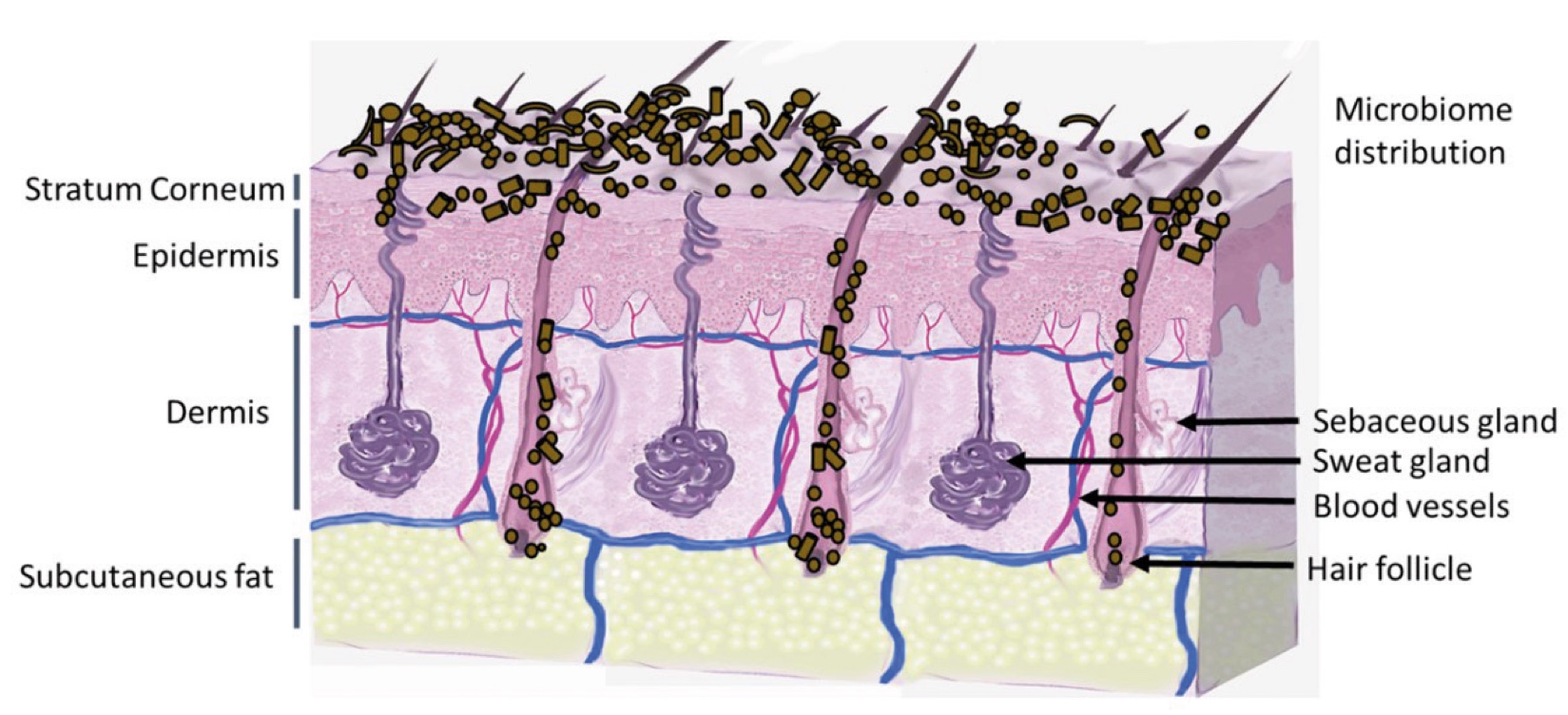
Figure 2. Skin Section with Microbiome. Most microorganisms live in the superficial layers of the stratum corneum and in the upper parts of the hair follicles. Some reside in the deeper areas of the hair follicles and are beyond the reach of ordinary disinfection procedures. There bacteria are a reservoir for recolonization after the surface bacteria are removed.
About the Author
GUIDO BOGNOLO
Guido Bognolo has over 30 years experience in technical development, products and business management in major surfactants multinational principals. Founder the WSA Associates for 15 years as a free-lance consultants he has advised major surfactants producers in technology, business development, investment strategies and acquisitions. He is the author of technical and marketing articles and chapters in reference books.

GUIDO BOGNOLO
Independent consultant, Belgium

References and notes
- Schonhoff, A., Stöckigt, G., Wulf, C., Zapp, P. and Kuckhinris, W. (2023) Biosurfactants production with substrates from sugar industry. Environmental, cost, market and social aspects. RSC Sustainability 1, 1798 https://pubs.rsc.org/en/content/articlelanding/2023/su/d3su00122a
- Elias, A.M., Andreza A. Longati, A.A., Ellamla H.R., Furlan, F.F., Ribeiro, M.P.A., Marcelino, P.R.F., dos Santos, J.C., da Silva, S.S. and Giordano, R.C. (2021) Techno-Economic-Environmental Analysis of Sophorolipid Biosurfactant Production from Sugarcane Bagasse. Ind. Eng. Chem. Res. , 60, 9833−9850 https://bvs.fapesp.br/en/publicacao/196046/techno-economic-environmental-analysis-of-sophorolipid-biosu/
- Kopsahelis, A., Kourmentza, C., Zafiri, C., et al. (2018). Gate-to-gate life cycle assessment of biosurfactants and bioplasticizers production via biotechnological exploitation of fats and waste oils. Journal of Chemical Technology and Biotechnology 93:2833–41 https://centaur.reading.ac.uk/75991/1/Kopsahelis_et_al-2018-Journal_of_Chemical_Technology_and_Biotechnology.pdf
- Wang, H., Tsang, C.-W., To, M. H., Kaur, G., Roelants, S. L. K. W., Stevens, C. V., Soetaert, W. and Lin, C. S. K. (2020) Techno-economic evaluation of a biorefinery applying food waste for sophorolipid productionA case study for Hong Kong. Bioresour. Technol. 303, 122852 https://repository.vtc.edu.hk/thei-fac-sci-tech-sp/492/
- Soares da Silva, R. d. C. F., de Almeida, D. G., Brasileiro, P. P. F., Rufino, R. D., de Luna, J. M. and Sarubbo, L. A. (2018) Production, formulation and cost estimation of a commercial biosurfactant. Biodegradation 30, 191−201. https://pubmed.ncbi.nlm.nih.gov/29725780/