
Multifunctional Ingredients
Skin care
KEYWORDS
Personal care;
Multifunctionality;
Formulation efficiency;
Hybrid beauty;
Skinimalism
INDUSTRY PERSPECTIVE
Multifunctional Cosmetic Ingredients: The Growing Power of Innovation in Personal Care
Elodie Alves
Senior Analyst, Chemicals & Materials at Kline + Company, France
ABSTRACT: Multifunctional ingredients are no longer a formulation shortcut; they are a strategic response to how beauty value is being redefined. As consumers demand simpler routines, clean, and short INCI lists, and high-performance hybrid products, the industry is rethinking the role of every raw material in formulations. Ingredients that deliver functional, sensorial, and active benefits are emerging as key factors of market differentiation. Across global markets, multifunctionals help brands enhance formulation efficiency, reduce reliance on scrutinized ingredients, and improve value-for-money amid economic pressures. This article examines key ingredient categories, market dynamics, and emerging trends shaping the rise of multifunctionals and their expanding role in beauty innovation.
Introduction
Multifunctional ingredients deliver more than one benefit to a cosmetic formulation. For example, a single ingredient might simultaneously hydrate the skin, act as an antioxidant, and provide antimicrobial protection. This convergence of benefits is not just a technical achievement; it reflects a broader shift toward smarter, more resilient formulation design that balances efficacy, simplicity, and scrutiny in equal measure.
We distinguish two types of multifunctionality in personal care formulations. In some cases, a single multifunctional ingredient can deliver both functional benefits, such as texturizing, stabilizing, or preserving, and active benefits like moisturizing, soothing, or protecting. In other cases, a multifunctional ingredient excels by offering more than one benefit within each category, delivery several functional roles at once or multiple active outcomes. This makes it an especially efficient and versatile choice for formulators.
For brands and formulators, multifunctional ingredients unlock value well beyond formulation convenience. They enable shorter, more transparent INCI lists, improve cost-effectiveness of formulations, and reduce complexity across sourcing and manufacturing. At the same time, they align with evolving consumer expectations for simpler routines, cleaner positioning, and products that justify their price through performance. In this sense, multifunctionals are not just efficiency tools; they are a direct response to how consumers now evaluate credibility, value, and innovation in personal care.
Beyond efficiency and performance, multifunctional ingredients are increasingly valued for their role in formulation risk management. The use of preservative boosters or UV boosters allow formulators to reduce reliance on ingredients facing heightened regulatory or consumer scrutiny, such as parabens, phenoxyethanol, or certain organic UV absorbers. Multifunctional ingredients help brands navigate tightening regulations and evolving consumer expectation while maintaining product performance, stability, and sensorial appeal. By relying on these ingredients, formulators can design more resilient products from the start, rather than reacting to ingredient restrictions or consumer pushback.
Multifunctionals: A Market on the Move
The demand for multifunctional ingredients continues to accelerate across global beauty markets as consumers increasingly prioritize simplicity, efficiency, and high-performance in their personal care routines. This shift is driven not only by economic pressures, but by structurally higher ingredient awareness, changing lifestyles, and a desire for simplified yet effective self-care. As a result, brands are pivoting toward multifunctional actives, hybrid textures, and formulation-efficient solutions that deliver tangible benefits with fewer inputs. The following overview explores how this transformation is unfolding across global markets and highlights the versatile ingredients that are reshaping modern beauty formulations. Based on Kline’s ongoing tracking of personal care ingredients trends through 2025, multifunctionals are increasingly seen not merely as formulation aids but as strategic compounds that enhance product value, performance, and consumer perception.
One Global Shift, Multiple Market Logics
Across major regions, the push toward multifunctionality is shaped by a mix of cultural, economic, and regulatory drivers.
- The rise of skinimalism, in Europe and the United States, reinforced by economic pressures, drives consumers toward shorter INCI lists and hybrid products that deliver multiple benefits in fewer steps.
- Fast-paced urban living in China is fueling interest for streamlined routines supported by multifunctional actives that promise efficiency without compromising performance.
- In India, especially among urban Millennials and Gen Z, minimalist, active-led formulations and all-in-one products are preferred for their convenience, value, and suitability to the country’s hot, humid climate.
- The shift toward simplified skincare is evident in Japan in the rise of hybrid formats, such as serum-toner and lotion-emulsions, that rely on multifunctional ingredient that deliver layered benefits with fewer products.
- South Korea’s innovation-driven landscape favors multifunctional and cost-competitive ingredients, helping consumers over choice paralysis created by abundant product launches caused by the international craze of K-Beauty.
Economic volatility in Brazil pushes consumers and brands toward efficiency-focused, high-value multifunctional products with simpler, fewer-ingredient formulations.
Core Ingredient Categories Driving Growth
The global personal care industry includes a broad and evolving palette of multifunctional ingredients, each becoming essential for creating high-performance formulations. Their value comes not only from the benefits they provide individually, but from their ability to streamline multiple formulation needs into fewer, smarter ingredients.
- Esters highlight this convergence, functioning as lightweight emollients that deliver a smooth, elegant skin feel while doubling as efficient emulsifiers capable of stabilizing increasingly complex formulation systems.
- Hyaluronic acid extends well beyond hydration. While best known for its humectant properties, it also functions as viscosity enhancer and serves as a targeted bioactive, reinforcing its multifunctional role across both structure and efficacy.
- Niacinamide (vitamin B3) plays a similarly versatile role, supporting formula stability and viscosity while delivering well established benefits in skin brightening and barrier reinforcement, making it a cornerstone of modern, minimalist formulations.
- Panthenol (vitamin B5) combines functional and sensorial value by enhancing moisture retention, improving skin softness, and soothing irritation, allowing formulators to address comfort and performance simultaneously.
- Foundational compounds like glycerin serve as powerful humectants and reliable solvents, while squalane, chitosan, ceramides, and natural oils enrich formulations by combining emolliency with bioactive support for skin health and resilience.
- To optimize preservation without heavily relying on traditional and scrutinized preservatives, multifunctional preservative boosters, such as ethylhexylglycerin, caprylyl glycol, hydroxyacetophenone, and various diols, enhance microbiological protection while simultaneously acting as humectants, solvents, or sensorial enhancers.
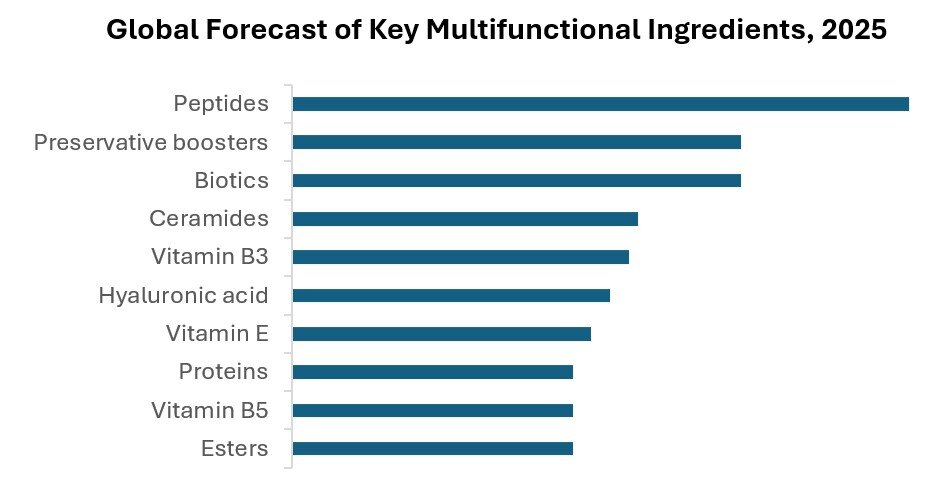
Collectively, these ingredients reflect a growing industry shift toward smarter, more efficient formulation design. The market of key multifunctional ingredients is expected to grow at a 4.0% CAGR, with peptides, preservative boosters, and biotics emerging as the fastest-growing categories. These ingredients benefit from rising demand for science-backed actives, microbiome-focused care, and formulation efficiency. Meanwhile, more established ingredient groups, such as esters and vitamins, continue steady growth as reliable multifunctional components within high-performance formulations. Together these dynamics underscore how multifunctionality is evolving from formulation preference to a defining market strategy.
The factors Accelerating Multifunctional Growth
As the global beauty market continues to evolve, several opportunities are accelerating the adoption of multifunctional ingredients in personal care products. Yet, despite their advantages for innovation and efficiency, these ingredients also bring challenges. The trends below summarize the primary drivers shaping market demand.
Skinimalism: Fewer Steps, More Benefits
The growing momentum of skinimalism and minimalist beauty is driving brands to seek multifunctional ingredients that deliver two or more benefits in a single product, helping reduce formulation complexity while maintaining high performance. This shift aligns with consumer demand for shorter INCI lists and clean formulations, creating opportunities for ingredients that can replace multiple components and enhance value perception.
This shift is especially prominent in Europe and the United States, where economic pressures and ingredient transparency expectations reinforce demand for formulations that are simple, safe, and effective. For example, favoring ingredients that combine moisturizing, soothing, and film-forming benefits, reducing both formulation complexity and production cost.
Beyond simplicity, consumers increasingly associate streamlined formulas with transparency and safety. As a result, multifunctional ingredients are becoming essential for formulators aiming to meet modern expectations for clarity, performance, and ingredient-conscious beauty.
Hybrid Beauty: Cross-Category Product Innovation
At the same time, the rise of hybrid product formats, such as tinted serums, SPF moisturizers, toner-serums, cleansing oils with treatment benefits, and makeup infused with actives, is expanding the need for multifunctional ingredients that remain stable across diverse product forms, offer both functional and sensory benefits, and integrate seamlessly into complex hybrid matrices.
As these cross-category formulas continue to blur the lines between skincare, suncare, and makeup, formulators increasingly rely on versatile solutions that can perform reliably under varied pH ranges, viscosities, and emulsification systems. For example, peptides used in tinted serums must deliver anti-aging benefits while integrating seamlessly with pigments and UV absorbers. Similarly, multifunctional emollients and esters support hybrid textures by providing a smooth application while also stabilizing dispersed phases.
This trend stems from Japan and South Korea, where elegant texture and versatility are core to product innovation.
Cost-Performance Balance: High Value Under Economic Pressure
Economic uncertainty and global inflation further amplify the appeal of multifunctional solutions, enabling brands to lower formulation costs without compromising efficacy and consumer-perceived performance.
Multifunctional ingredients provide a clear competitive advantage by reducing the number of raw materials, lowering storage and handling costs, and enhancing value-for-money positions for budget-conscious consumers.
Additionally, the growth of active-led formulations reflects consumers’ desire for higher-performance products, creating opportunities for multifunctional actives such as anti-aging and brightening peptides, antioxidant and calming botanicals, and microbiome-friendly fermented ingredients that also deliver hydration. These multifunctional ingredients allow brands to build more compelling claims while minimizing formula complexity, meeting consumers’ expectations for science-backed benefits within simple, more cost-efficient formulations.
Limitations and Formulation Challenges
Multifunctional ingredients, while highly useful, also present several disadvantages and challenges in personal care formulations. In some cases, they may be less potent than single‑function ingredients designed for a specific, targeted role. For example, antimicrobial multifunctionals often require higher concentrations to ensure adequate protection. Increasing their dosage, however, can negatively affect a product’s aesthetics, sensorial profile, or stability.
Higher required concentrations may also raise formulation costs, reducing the economic advantage multifunctional ingredients typically offer.
In addition, achieving optimal performance depends heavily on stability, bioavailability, and compatibility with other formulation components; factors that can be more difficult to control when one ingredient is expected to deliver multiple functions. These considerations make the use of multifunctional ingredients both an opportunity and a formulation challenge.
Conclusion
As the personal care industry continues to evolve, multifunctional ingredients have emerged as essential drivers of formulation innovation. They enable brands to simplify increasingly complex formulations without compromising performance, sensorial quality, or consumer appeal. Their ability to deliver multiple benefits, whether functional, sensorial, or active, supports key markets trends of minimalism, hybrid beauty, and value-driven performance. Their growing importance, however, raises the bar for formulation expertise, requiring careful consideration of stability, compatibility, and optimal dosing to fully unlock their potential. As innovation in biotechnology and green chemistry accelerates, multifunctional ingredients will play an increasingly important role in helping brands meet the demand for simpler, smarter, and science-backed personal care solutions.
About the Author
Elodie Alves is a senior analyst in the Chemicals and Materials business at Kline + Company. She has over seven years of experience in market intelligence and due diligence, providing comprehensive market analysis tailored to the evolving needs of the specialty chemical industries, including personal care.

Elodie Alves
Senior Analyst, Chemicals & Materials at Kline + Company, France

References and notes
- Kline + Company, Specialty Actives in Personal Care: Global Market Analysis and Opportunities, 2024
- Kline + Company, Personal Care Ingredients: Market Analysis and Opportunities, 2023, 2025