Panel discussion on...
How AI is Speeding
Up Beauty & Personal Care Innovation
About the Author
Ashlee Cannady

Director, Strategic Marketing, Amyris
About the Author
Dmitry Grapov
Vice President, Computing, Amyris

About the Author
Adam Meadows
Director, Data Science, Amyris

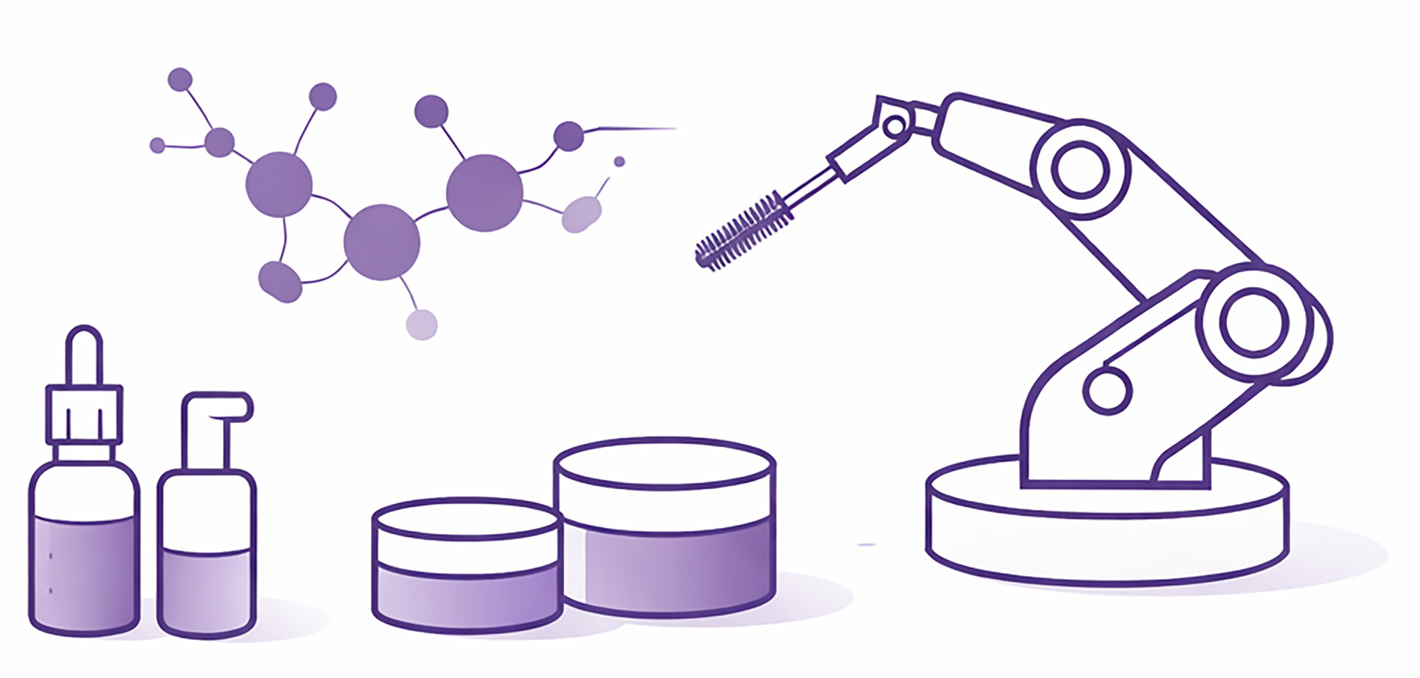
Biotechnology and biomanufacturing have reshaped the landscape of ingredient sourcing for beauty and home care - delivering a degree of purity, performance, and sustainability that are unmatched by traditional production methods. Biomanufacturing of industry workhorse molecules has reduced reliance on volatile agricultural supply chains and animal supply chains. It has also unlocked access to scarce or hard-to-source natural molecules at commercial scale. Now, the fusion of biomanufacturing with AI is propelling a new wave of innovation. In this article, we share how AI has influenced two major workflows based on our team’s direct experience.
First, we integrate AI tools throughout our core biomanufacturing platform, which spans enzyme design, high-throughput screening, fermentation process optimization, and manufacturing. Within each of these core capabilities, AI shortens development cycles and delivers new ingredients more quickly and predictably.
Second, we use AI to accelerate ingredient design. Our platform unlocks access to sophisticated chemistries derived from nature, most of which have never been available at scale before; AI helps us connect these chemistries to beauty and home care formulation. Advanced proprietary models enable mapping of structure-function relationships, identification of high potential applications, and entirely new ingredient families that were previously out of reach.
Ultimately, we see the convergence of AI and biomanufacturing resulting in more sustainable, higher performing products for the consumer, while accelerating the time to commercialization.
AI in Enzyme Design
The proprietary microbes we use in biomanufacturing are living factories which convert sugars into target molecules using enzymes. AI-driven enzyme design is now foundational to our platform. We use a variety of protein AI models, including protein language models and structure models, to predict the functional consequences of amino acid changes, anticipate substrate specificity, and recommend beneficial mutations that expand catalytic performance beyond what intuition or evolutionary reasoning alone might suggest.
For beauty and personal care ingredients needing high purity, this enables quicker enzyme identification and reduces lab cycles. Enzyme design AI reduces the search space, points toward promising variants, and ultimately elevates the baseline performance of the strains that feed into downstream processes.
Better Data, Better Decisions: AI for High‑Throughput Screening
To create efficient microbial factories, we developed a highly automated high-throughput screening (HTS) platform which can analyze thousands of candidate microbe strains a day. Historically, these datasets can be challenging to analyze because we often look for small improvements and real biological systems are notoriously sensitive to small changes in their environment. Analytical instrument drift, assay artifacts, batch effects, and untracked environmental shifts all present challenges to identifying real strain improvements.
AI-assisted data quality pipelines can automatically correct, normalize, and classify these data, turning raw measurements into cleaner, more comparable datasets. This quality foundation is essential because everything downstream (model training, decision recommendations, and automated experiment selection) depends on trustworthy data. AI incorporation has helped our HTS platform evolve from a pure measurement engine into a measurement plus analysis system, where each round of data generation directly triggers refined predictions for the next round of experimentation.
AI for Fermentation Process Optimization
Once we have a highly productive microbe, the next step is to develop a fermentation process that maximizes its performance in a scalable process. Fermentation processes typically involve dozens of interdependent parameters, feeding profiles, dissolved oxygen settings, agitation sequences, induction strategies, all of which must be tuned for each new strain.
A new class of AI-enabled systems is emerging to address this challenge. These systems integrate real-time estimation of performance indicators and adaptive optimization algorithms that recommend new conditions in real time. In practice, this compresses what used to be dozens of stand‑alone fermentation runs into faster, information‑dense optimization cycles. By learning while the experiment is still running, these systems significantly accelerate the path to manufacturing‑ready performance.
AI in Manufacturing
AI is a necessity in analyzing our manufacturing process data, ensuring our microbes thrive at the industrial scale and that the ingredients they make consistently meet product specifications and hit our cost targets. With over a billion data points collected each day at our advanced precision fermentation facility in Brazil, AI models can identify subtle signatures of process deviations hours before traditional alarms would trigger. By catching these issues early, we ensure a reliable supply chain of high-quality ingredients. In addition, we use AI to continuously improve the efficiency of our processes. By mapping our energy and material costs directly to operational steps, we can diagnose and address root causes of waste in real-time. The result is a more sustainable process with a lower carbon footprint.
AI-Assisted Ingredient Design
While AI helps optimize biomanufacturing, another frontier is opening upstream: AI-powered design of innovative renewable ingredients. At Amyris, our core platform enables scalable production of chemistries from nature that have no molecular equivalent in petrochemical supply chains or today’s plant-derived portfolios. To unlock these new chemistries in the market, we need to connect molecular structure to ingredient function.
Here, AI tools have enabled a new ingredient ideation pathway: the model can sort through the unique chemistry accessible through our platform and filter down to candidates most likely to perform in formulation. Human experts then validate final selections. This pipeline has enabled us to identify molecular scaffolds not obvious through conventional design thinking, giving formulators and R&D teams a richer palette to work from.
Conclusion
The integration of AI with advanced biomanufacturing enables a deeper understanding of biological design space and a more precise translation of that knowledge into functional ingredients. This combined approach strengthens scientific decision making, accelerates discovery, and expands our ability to develop renewable ingredients that meet the evolving needs of beauty and personal care.
References and notes
Panelists

Carina Dewar
Product Developer, Amka Products (Pty) Ltd

Ashlee Cannady
Director, Strategic Marketing, Amyris
Anastasiia Kharina
Senior Regulatory Affairs Expert, Angel Consulting Srl

Boris Gaspar
Head of Market Development Personal Care EMEA, BASF Personal Care and Nutrition GmbH

Clarisse BAVOUX
Toxicologist and Deputy Chief Executive Officer in charge of digital solutions, CEHTRA

Cécile GUYOT
Communication Manager, COPTIS

Rainer Kröpke
Cosmetic scientist, entrepreneur and founder of Cosmacon GmbH, Tojo Cosmetics GmbH, Cosactive GmbH and Innosicos GmbH

Yann Chilvers
Founder & Co-CEO, Covalo AG

Perry Romanowski
Cosmetic Chemist, Vice President Element 44 Inc
Elsa Jungman
Founder & CEO, HelloBiome

Olga V. Dueva-Koganov
VP and co-founder of Intellebio LLC

Eva Criado
Sr. Marketing & Communications Manager, Kensing

Carrie Mellage
Vice President, Beauty, Kline+Company
Sue Sender
Director of Marketing, Micro Powders

Dr. Mark Smith
NATRUE Director General

Francesco Ringressi
Business Development Manager, SEA Vision

Julie Rojas
AI Scientist, SMEY

Rania Ibrahim
Founder SkinScience Analytics, USA
Nele Ameloot
Head of BioMolecules Business Development Center, Ghent University, Belgium
Lorena Bellas Domínguez
In Vivo Efficacy Test Manager, Zurko Research