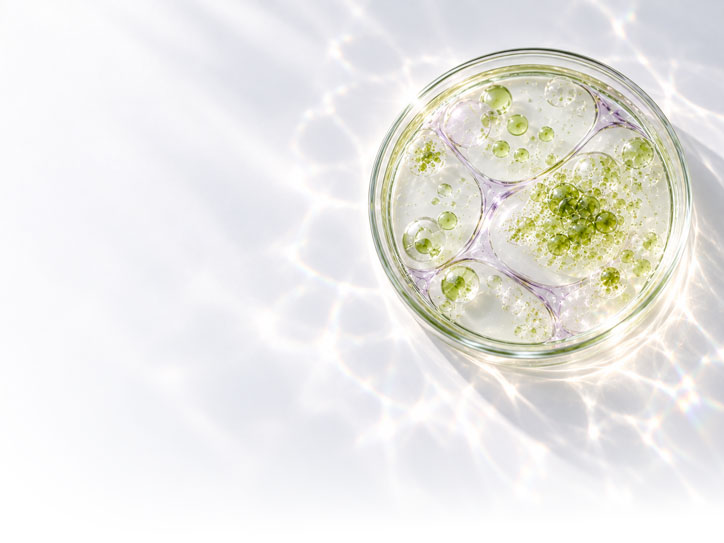
Panel discussion on...
Biotech Innovations in Personal & Home Care
About the Author
Annie Tsong

SVP of Corporate & Scientific Affairs, Amyris

About the Author
Ashlee Cannady
Director of Strategic Marketing, Amyris

Function-First Design: The Next Phase of Biotechnology in Personal and Home Care
The first wave of biotechnology in personal care and home care focused on sustainability and supply chain resilience. Precision fermentation and related biomanufacturing technologies made it possible to more dependably and sustainably produce ingredients that once depended on botanical extraction, animal-derived sources, or complex petrochemical processes. Squalane and hyaluronic acid are well-known examples: historically sourced from animal origins, they are now predominantly produced through precision fermentation. Successes like these established biotechnology as a reliable manufacturing approach for the industry while reducing exposure to volatile raw material supply chains.
Today, the industry’s focus is shifting. The opportunity is no longer limited to replacing existing materials with more renewable versions. Increasingly, Biotechnology is enabling access to new chemistries, novel functionalities, and ingredient concepts that would be difficult or impossible to commercialize through conventional routes. In other words, biotechnology is evolving from a production platform into a design platform, and a function-first approach is emerging as the framework for execution.
Hemisqualane, a cosmetic emollient, is an early example of this function-first approach. It was developed to solve a defined formulation need rather than to substitute for an existing material, and the result is an innovative ingredient with a lightweight sensory profile and an alternative to traditional silicones. Biotechnology made it possible to build an ingredient around a target performance attribute, and the result was a differentiated renewable ingredient with clear consumer benefits. Designing toward a desired function rather than reproducing what already exists is becoming a defining trait of the next phase of biotechnology.
In function-first pipelines, development begins by identifying a market need and the formulation performance required to meet it. Researchers then determine the physicochemical properties needed to achieve that outcome and identify biological pathways capable of producing molecules with those characteristics. We move from “Can biology make this molecule?” to “What is the ideal renewable molecule that could best solve this problem?”
The importance of this shift becomes clear given the scale of the biological design space now available due to advances in precision fermentation. Fermentation can access chemistries that have no practical equivalent in traditional agricultural or petrochemical supply chains, delivering a dizzying array of molecular structures and functional groups. Rather than working from a relatively fixed set of raw materials, formulators and ingredient developers can explore a much wider universe of molecular possibilities. Artificial intelligence is also accelerating this transition. Now applied at every step of a biotechnology process, from enzyme engineering and strain optimization to manufacturing operations and ingredient discovery, AI is enabling function-first workflows at a completely new scale, scanning a much broader set of biological possibilities to connect market needs to molecular structures to ingredient function.
The companies that succeed in maximizing the full breadth of chemistry now available at scale will do so by combining biological design expertise, manufacturing, and formulation insights, to deliver meaningful improvements in product performance.
References and notes
References and notes
Panelists
Annie Tsong
SVP of Corporate & Scientific Affairs, Amyris
Ashlee Cannady
Director of Strategic Marketing, Amyris


Alex Rosay
CEO, Cascade Bio

Rafael Bíscaro
Global Product Marketing Manager, Personal Care, Chemyunion

Tony Abboud
Chief Commercial Officer, Core Biogenesis

Lisa Heida
Marketing Lead, Covalo
Alex Lorestani
Co-Founder & CEO, Geltor
Sharief Barends
Global BioActives Research Director, IFF Health & Biosciences - IFF

Davide Mariani
Senior Expert Home & Personal Care Products, Innovhub SSI

Olga V. Dueva-Koganov
VP and co-founder of Intellebio

Denis Bendejacq
SVP Research & Innovation, Kensing

Dexter Hsu
Chief Executive Officer,
LCY Biosciences Inc.

Olya Vvedenskaya
Senior communications manager, Lipotype

Marc Desmarais
Product Development Activist, Origin by Ocean
Giorgio Carelli
Product Manager Personal Care, ROELMI HPC

Julie Diamond
Bioprocessing Sales Specialist, RoosterBio, Inc.

Ilaria Campestri
Pharmacist, Chemist Cosmetologist & Nutritionist

Claire Liu
Digital Marketing Project Manager - Cosmetics & Nutrition Active ingredients, Seppic

Martina Herrmann
Director Process Development, Global Innovation Cosmetic Ingredients, Symrise

Jacqueline Scarborough
Director, Consumer Care,Tate & Lyle

Spencer Marsh
Chief Scientific Officer, The Tiny Cargo Company

Òscar Expósito
CEO, CSO and co-founder of
Vytrus Biotech S.A.

Lorena Bellas Domínguez
In Vivo Efficacy Test Manager,
Zurko Research