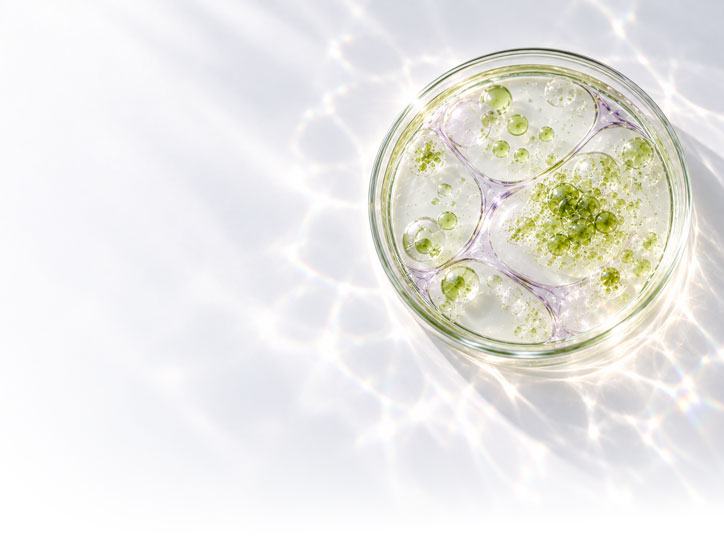
Panel discussion on...
Biotech Innovations in Personal & Home Care
About the Author
Denis Bendejacq

SVP Research & Innovation, Kensing

Beyond Ingredient Replacement: How Biotechnology Is Redefining Formulation Design
Biotechnology is increasingly appearing across many layers of personal care and home care—from ingredient development and manufacturing to material innovation and product performance. Where do you see the most meaningful shifts happening today?
One of the most meaningful shifts is the emergence of biotechnology-derived materials with the potential to reshape how consumer products are conceived and formulated. The current wave focuses on fermentation-based ingredients with demonstrably lower carbon footprint compared to conventional chemistries. The mainstream technologies underpinning today’s personal care and home care products were developed decades ago and, although highly effective and cost-efficient, they increasingly struggle to meet evolving sustainability expectations. More than simply aiming to offer functional alternatives, biotechnology is creating entirely new classes of materials that enable formulators to rethink product architectures, unlock novel functionality, creating new intellectual property opportunities. The conversation is shifting from ingredient substitution toward formulation redesign, product reinvention - and ultimately the creation of consumer benefits that were difficult to achieve with conventional chemistry alone.
Beyond sustainability or ingredient replacement, how is biotechnology influencing the way products perform or are experienced by consumers?
The performance of the first biotech-derived ingredients has not yet matched that of the benchmarks established by conventional industry workhorses. However, successful adoption does not necessarily require full one-to-one replacement. The practical pathway for innovations is often incremental, with new ingredients formulated alongside existing technologies in ways that are affordable, compatible or even synergistic. This allows brands to preserve the performance attributes consumers expect, while gradually changing the makeup of their products. The sulfate-free movement provides a useful precedent: despite initial challenges related to cost and consumer acceptance, sustained investment ultimately made sulfate-free mainstream in major product categories. Biotechnology may follow a similar trajectory. The first generation may not outperform conventional technologies on every metric, but it does not need to. As it brings meaningful sustainability benefits while progressively improving performance, it will gradually reshape consumer expectations and ultimately transform entire product categories.
Many early biotechnology stories focused on creating more sustainable alternatives to existing materials. What do you think is emerging as the next phase of biotechnology in personal care/home care?
The industry’s initial focus on developing more sustainable variants of existing ingredients was an important first step, but the next phase is likely to be defined by multifunctionality. Rather than serving a single purpose, biotech-derived ingredients have the potential to deliver multiple benefits simultaneously, combining performance, sustainability, and consumer-facing attributes within the same material. This opens the possibility of creating formulations that do not simply replicate existing products but instead offer new combinations of functionality and sensorial experiences. As biotechnology platforms mature, the winners will be the ones that allow formulators to simplify formulations, reduce ingredient counts, and strengthen consumer confidence in these new-generation formulations while demonstrably improving sustainability. A renewed consumer experience that conventional technologies were never designed to deliver.
As biology becomes more integrated into how products and materials are conceived, made, and experienced, do you think the industry is beginning to move from simply using biotechnology toward designing with biology? If so, what new skills, collaborations, or ways of thinking will this require?
Achieving the scale and speed required to meet ambitious 2030 sustainability commitments demands a fundamental change in how innovation is organized. Building deep biotechnology capabilities internally often requires substantial investment and long development timelines that are difficult to justify under traditional return-on-investment models. As a result, innovation is becoming more collaborative and ecosystem-driven. Established companies must partner with specialized biotechnology start-ups, leveraging expert formulation and testing laboratories, working with life-cycle assessment specialists to substantiate sustainability claims, and engaging with regulatory stakeholders to help establish appropriate frameworks for these emerging technologies. This represents an approach in which biology, formulation science, manufacturing, sustainability assessment, and regulation are developed in parallel rather than sequentially.
Despite the excitement around biotechnology, what limitations, tensions, or unresolved questions still need to be addressed within personal care/home care?
The most immediate constraints are industrial scale and economics, which influence both availability and cost-in-use. But there are also important scientific questions. Academic literature frequently highlights the multifunctional potential of many biotech-derived ingredients, but translating those benefits into complex commercial formulations will require extensive formulation development to determine how these materials behave in mixtures, how their dose-response relationships evolve in the presence of conventional surfactants and additives, and whether their claimed benefits are enhanced, preserved, or diminished within finished formulations. Although several actors in the industry have already started generating real-world evidence of the scale and potential of biotech ingredients, there is still a long way to go. But if biotechnology truly has the potential to transform the sustainability profile of our industry, then it deserves the same level of long-term commitment and investment that we collectively devoted to petrochemicals and oleochemicals over the last four or five decades.
Looking ahead, what kinds of products/materials do you think biotechnology may enable that feel genuinely new or difficult to achieve through conventional approaches?
The most transformative opportunity lies in developing low-carbon, potentially carbon-negative materials using locally sourced waste feedstocks. Unlike conventional oleo and petrochemical pathways, biotechnology offers the possibility of converting underutilized streams into higher-value functional ingredients with significantly reduced environmental impact. With appropriate feedstock availability and manufacturing scale, these technologies will change how the industry sources carbon and designs supply chains. This is particularly relevant at a time when the sustainability of many existing feedstocks continues to be scrutinized, with palm-derived materials being a notable example. Biotechnology is more than a new manufacturing route. It offers the possibility of redesigning how carbon flows through our industry - from waste streams to finished products - and creating environmental performance profiles that conventional approaches simply cannot replicate.
References and notes
References and notes
- M. Koganov, O. Dueva-Koganov, A. Duev, L. Zhang. Multifunctional Sustainable Zeta Fractions from Living Plants. Sofw journal. 2017; 143, 1+2/17: 42-47. https://www.ashland.com/file_source/Ashland/Industries/Personal%20and%20Home%20Care/Articles/170102_PDF_Ashland_Koganova_E.pdf
- Koganov, M. US 7,442,391, Bioactive botanical cosmetic compositions and processes for their production and use. https://patents.google.com/patent/US7442391B2/en?oq=US+7%2c442%2c391
- Koganov, M. EU 2,919,757, A method for preparing bioactive botanical compositions and the compositions made from said method using an electromagnetic field of grater than 3 GHz. https://patents.google.com/patent/EP2919757B1/en?oq=EU+2%2c919%2c757
- Koganov, M. US 7,537,791, Parthenolide free bioactive ingredients from Feverfew (Tanacetum parthenium) and processes for their production. https://patents.google.com/patent/US7537791B2/en?oq=US+7%2c537%2c791
- Koganov, M., Dueva-Koganov O., Duev A. et.al. EP4447927A1, Bioactive serum fractions from fresh rose flowers and methods for their preparation and uses. https://patents.google.com/patent/EP4447927A1/en?oq=US20260124266A1
- Koganov, M., Dueva-Koganov O., Duev A. et.al. US20260124266A1, Skin care compositons comprising synergistic blend of sacred lotus and tea plant or sacred lotus and german chamomile and cosmetic applications thereof. https://patents.google.com/patent/US20260124266A1/en?oq=US202601242
- Stredansky M., Stredanska S. EP4700131A1, Process of preparing cosmetic ingredients containing active components from plant or algae biomass, European Patent Application, 2024. https://patents.google.com/patent/EP4700131A1/en
Panelists

Annie Tsong
SVP of Corporate & Scientific Affairs, Amyris

Ashlee Cannady
Director of Strategic Marketing, Amyris


Alex Rosay
CEO, Cascade Bio

Rafael Bíscaro
Global Product Marketing Manager, Personal Care, Chemyunion

Tony Abboud
Chief Commercial Officer, Core Biogenesis

Lisa Heida
Marketing Lead, Covalo
Alex Lorestani
Co-Founder & CEO, Geltor
Sharief Barends
Global BioActives Research Director, IFF Health & Biosciences - IFF

Davide Mariani
Senior Expert Home & Personal Care Products, Innovhub SSI

Olga V. Dueva-Koganov
VP and co-founder of Intellebio
Denis Bendejacq
SVP Research & Innovation, Kensing

Dexter Hsu
Chief Executive Officer,
LCY Biosciences Inc.

Olya Vvedenskaya
Senior communications manager, Lipotype

Marc Desmarais
Product Development Activist, Origin by Ocean
Giorgio Carelli
Product Manager Personal Care, ROELMI HPC

Julie Diamond
Bioprocessing Sales Specialist, RoosterBio, Inc.

Ilaria Campestri
Pharmacist, Chemist Cosmetologist & Nutritionist

Claire Liu
Digital Marketing Project Manager - Cosmetics & Nutrition Active ingredients, Seppic

Martina Herrmann
Director Process Development, Global Innovation Cosmetic Ingredients, Symrise

Jacqueline Scarborough
Director, Consumer Care,Tate & Lyle

Spencer Marsh
Chief Scientific Officer, The Tiny Cargo Company

Òscar Expósito
CEO, CSO and co-founder of
Vytrus Biotech S.A.

Lorena Bellas Domínguez
In Vivo Efficacy Test Manager,
Zurko Research