
Panel discussion on...
Biotech Innovations in Personal & Home Care
About the Author
Lorena Bellas Domínguez

In Vivo Efficacy Test Manager,
Zurko Research

Rethinking Sustainability: How Biotechnology Is Transforming Product Performance and Consumer Experience in Personal Care
Biotechnology has become one of the most significant drivers of innovation in the Personal Care industry. In recent years, much of the discussion has focused on its contribution to sustainability, reducing dependence on petrochemical- or animal-derived raw materials, and enabling more efficient production processes. However, limiting the impact of biotechnology to these benefits alone would oversimplify a much broader transformation.
Beyond sustainability, biotechnology is redefining how products work, the benefits they can deliver, and how consumers perceive and experience their efficacy.
One of the most significant changes is the development of ingredients capable of interacting with biological systems in increasingly targeted ways. Unlike traditional approaches focused on general benefits such as hydration, cleansing, or protection, many current biotechnological innovations aim to modulate specific biological mechanisms associated with skin, hair, and even their respective microbiomes.
Ingredients obtained through fermentation provide a clear example of this evolution. Fermentation technologies make it possible to produce complex molecules, metabolites, and bioactive compounds with functional profiles that are difficult to achieve through conventional methods. Hyaluronic acid produced by microbial fermentation is perhaps one of the best-known examples, demonstrating how biotechnology can improve ingredient production while maintaining high performance and quality standards.
Similarly, the development of biomimetic peptides through biotechnological approaches has significantly expanded the possibilities for influencing biological processes related to skin ageing, barrier function, and overall skin appearance. Postbiotics and fermented extracts are also gaining attention for their potential to support skin health and contribute to microbiome-friendly product concepts. Together, these innovations illustrate a broader shift towards ingredients designed not only to deliver cosmetic benefits but also to interact more precisely with biological pathways.
Another notable trend is the growing interest in ingredients such as PDRN (Polydeoxyribonucleotide). Traditionally associated with animal-derived sources, the market is now seeing the emergence of non-animal-derived alternatives produced through biotechnological processes, often referred to as “vegan PDRN”. These developments illustrate how biotechnology is not only creating new ingredients but also redefining existing categories through alternative production routes and improved sustainability profiles. More importantly, they reflect the industry’s increasing focus on developing ingredients with specific biological targets and measurable performance outcomes.
This technological evolution is also reshaping consumer expectations. As products incorporate increasingly sophisticated mechanisms of action, consumers expect benefits that are more precise, personalized, and supported by robust scientific evidence. Concepts such as the microbiome, biomimetic peptides, postbiotics, and PDRN have rapidly evolved from niche scientific topics into familiar terms within cosmetic innovation.
However, this growing sophistication creates an important challenge for the industry: objectively demonstrating that these biological mechanisms translate into meaningful and perceptible consumer benefits.
Traditional evaluation methodologies remain essential, but they increasingly need to be complemented by tools capable of capturing subtle and multidimensional changes. As mechanisms of action become more specific, demonstrating efficacy requires endpoints that go beyond traditional visual assessment, combining instrumental measurements, advanced imaging technologies, and consumer-perceived outcomes.
Advanced imaging systems, three-dimensional analysis, digital quantification of skin and hair parameters, instrumental biomarkers, and integrated assessment approaches are helping generate more robust evidence regarding the performance of biotechnology-based products. These methodologies provide a more comprehensive understanding of how products interact with biological systems and how those interactions ultimately translate into visible and measurable benefits.
This is particularly relevant because many next-generation ingredients do not simply claim visible improvements; they are designed to influence complex biological processes that require equally sophisticated methodologies for proper characterization and validation. As innovation continues to move closer to biological mechanisms, the ability to accurately assess product performance becomes increasingly important for both product developers and consumers.
For this reason, the future of biotechnology in Personal Care will not depend solely on the industry’s ability to develop new ingredients or manufacturing processes. It will also depend on its ability to measure, understand, and communicate the real-world impact of these innovations on product performance and consumer experience.
In this context, biotechnology is not only changing the products being developed but also transforming how efficacy is scientifically validated. This shift may ultimately prove to be just as important for the future of the industry as the biotechnological innovations driving it.
References and notes
References and notes
- Gu X, Li Z & Su J. Air pollution and skin diseases: a comprehensive evaluation of the associated mechanism. Ecotoxicology and Environmental Safety.2024;278:116429. https://www.sciencedirect.com/science/article/pii/S0147651324005050?via%3Dihub
- Pan TL, et al. The impact of urban particulate pollution on skin barrier function and subsequent drug absorption. Journal of Dermatological Science. 2015;78(1):51–60. https://www.sciencedirect.com/science/article/abs/pii/S0923181115000365
- Dijkhoff IM, et al. Impact of airborne particulate matter on skin: from epidemiology to in vitro studies. Particle and Fibre Toxicology. 2020;17:35. https://link.springer.com/article/10.1186/s12989-020-00366-y
- Vardoulakis S, et al. Indoor Exposure to Selected Air Pollutants in the Home Environment: A Systematic Review. International Journal of Environmental Research and Public Health. 2020;17:8972. https://www.mdpi.com/1660-4601/17/23/8972
- Liu Y, et al. A systematic literature review on indoor PM2.5 concentrations and personal exposure in urban residential buildings. Heliyon. 2022;8(8). https://www.cell.com/heliyon/fulltext/S2405-8440(22)01462-1?_returnURL=https%3A%2F%2Flinkinghub.elsevier.com%2Fretrieve%2Fpii%2FS2405844022014621%3Fshowall%3Dtrue
- Wierzbicka A, et al. Indoor PM2.5 from occupied residences in Sweden caused higher inflammation in mice compared to outdoor PM2.5. Indoor Air. 2022;32(12). https://onlinelibrary.wiley.com/doi/10.1111/ina.13177
- Yang W, Zhao B. Exposure to PM1 and PM2.5 among household cooking members. Building and Environment. 2025;283:113430. https://www.sciencedirect.com/science/article/abs/pii/S0360132325009059?via%3Dihub
- Zeng J, Kagi N & Umishio W. Transport and distribution of cooking-emitted particles in a residential environment. Journal of Asian Architecture and Building Engineering. 2026;25(2):1445–1460. https://www.tandfonline.com/doi/full/10.1080/13467581.2025.2602300
- Chen B, et al. Mechanisms of Sensitive Skin and the Soothing Effects of Active Compounds: A Review. Cosmetics. 2024;11:190. https://www.mdpi.com/2079-9284/11/6/190
- Zhou L, et al. The roles of skin Langerhans cells in immune tolerance and cancer immunity. Vaccines. 2022;10:1380. https://www.mdpi.com/2076-393X/10/9/1380
- Scheib N, et al. The dendritic cell dilemma in the skin: between tolerance and immunity. Frontiers in Immunology. 2022;13:929000. https://www.frontiersin.org/journals/immunology/articles/10.3389/fimmu.2022.929000/full
- Pan Y, et al. Langerhans cells: central players in the pathophysiology of atopic dermatitis. Journal of the European Academy of Dermatology and Venereology. 2025;39:278–289. https://onlinelibrary.wiley.com/doi/full/10.1111/jdv.20291
- Smith CH, et al. Effect of granulocyte macrophage-colony stimulating factor on Langerhans cells in normal and healthy atopic subjects. British Journal of Dermatology. 1998;139(2):239–246. https://academic.oup.com/bjd/article-abstract/139/2/239/6683565?__cf_chl_f_tk=3kN4GyGR0X0lDu0PrDT2Q.ECawAh51DxIKA.i7PZbH0-1782921229-1.0.1.1-R1tP2H1M_hFRheqzVCK6UkJrjvaf6WpPfwCFuIuUb5Y
- Expósito O, et al. Teaching urban skin to stay calm: the power of GM-CSF. Submitted to the IFSCC Congress 2026.
Panelists

Annie Tsong
SVP of Corporate & Scientific Affairs, Amyris

Ashlee Cannady
Director of Strategic Marketing, Amyris


Alex Rosay
CEO, Cascade Bio

Rafael Bíscaro
Global Product Marketing Manager, Personal Care, Chemyunion

Tony Abboud
Chief Commercial Officer, Core Biogenesis

Lisa Heida
Marketing Lead, Covalo
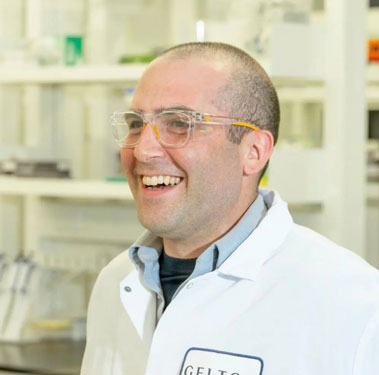
Alex Lorestani
Co-Founder & CEO, Geltor

Sharief Barends
Global BioActives Research Director, IFF Health & Biosciences - IFF

Davide Mariani
Senior Expert Home & Personal Care Products, Innovhub SSI

Olga V. Dueva-Koganov
VP and co-founder of Intellebio

Denis Bendejacq
SVP Research & Innovation, Kensing

Dexter Hsu
Chief Executive Officer,
LCY Biosciences Inc.

Olya Vvedenskaya
Senior communications manager, Lipotype

Marc Desmarais
Product Development Activist, Origin by Ocean

Giorgio Carelli
Product Manager Personal Care, ROELMI HPC

Julie Diamond
Bioprocessing Sales Specialist, RoosterBio, Inc.

Ilaria Campestri
Pharmacist, Chemist Cosmetologist & Nutritionist

Claire Liu
Digital Marketing Project Manager - Cosmetics & Nutrition Active ingredients, Seppic

Martina Herrmann
Director Process Development, Global Innovation Cosmetic Ingredients, Symrise

Jacqueline Scarborough
Director, Consumer Care,Tate & Lyle

Spencer Marsh
Chief Scientific Officer, The Tiny Cargo Company

Òscar Expósito
CEO, CSO and co-founder of
Vytrus Biotech S.A.

Lorena Bellas Domínguez
In Vivo Efficacy Test Manager,
Zurko Research