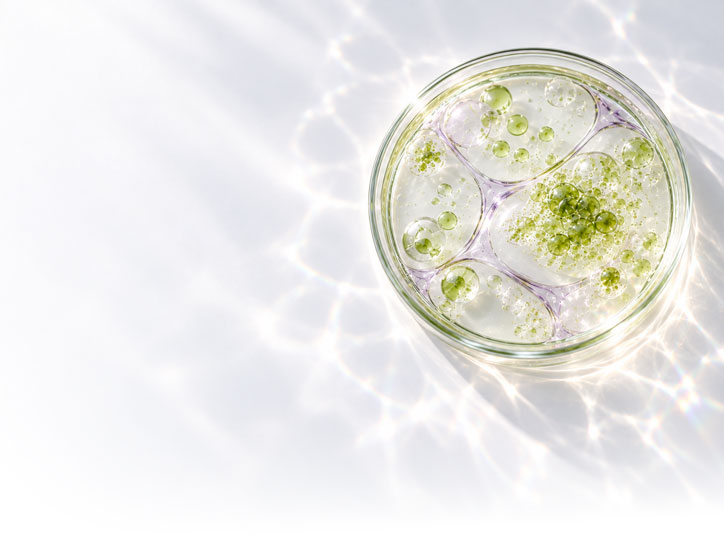
Panel discussion on...
Biotech Innovations in Personal & Home Care
About the Author
Jacqueline Scarborough

Director, Consumer Care,Tate & Lyle

Biotechnology at the next level: enhancing performance and consumer experience
We’ve long used biotechnology in personal and home care, but its purpose is changing. Early developments focused primarily on replacing synthetic or resource-intensive ingredients with bio-based alternatives. Today, the industry is moving into a more advanced phase, where biotechnology is not only about substitution, but about designing smarter materials that enhance how products perform and are experienced.
Improving product performance through biotechnology
In its initial phase, biotechnology helped enable a transition towards more sustainable formulations. Fermentation technologies have enabled the production of ingredients such as xanthan gum, gellan gum, diutan gum, and fermentation-derived cellulose that are nature-based, improving consistency and reducing reliance on traditional extraction or fossil-based inputs.
Now we’re seeing that this extends beyond simply swapping one ingredient for another. Biotechnology is increasingly being used to design ingredients with precise functional roles. Through fermentation, it is possible to control molecular structure in ways that translate directly into tailored performance—whether that is rheology, stability, or compatibility with complex formulation systems. For example, fermentation-derived cellulose can create a unique three-dimensional network that enhances suspension and stability, even in demanding environments such as high-surfactant systems or low-water formulations.
Importantly, replacing synthetic materials today is rarely about a single ingredient. It is increasingly achieved through tailored combination of bio-based solutions, supported by formulation expertise. By combining different nature-based hydrocolloids—such as xanthan gum for flow behaviour, diutan gum for suspension and smoothness, or gellan gum for structuring—formulators can recreate the performance of traditional synthetic systems. The outcome depends not only on the ingredients themselves, but on how they interact within a formulation. This is where application knowledge becomes critical: understanding how to balance rheology, stability, compatibility, and process conditions to deliver the desired result. In this way, biotechnology is not just providing new materials—it is enabling more sophisticated formulation design.
Elevating consumer experience
Consumer preference is ultimately driven by product performance and sensory experience. This is where biotechnology is increasingly shaping innovation.
Bio-based ingredients, particularly hydrocolloids produced by bio-fermentation, play a central role in defining texture, appearance, and feel. They allow formulators to create a broad spectrum of formats—from light, fluid systems to structured gels—supporting both functionality and differentiation.
These ingredients directly influence how consumers feel and experience products. Rheology modifiers such as xanthan gum deliver shear-thinning properties, enabling easy spreading while maintaining stability at rest. Others, such as diutan gum, contribute to smoother application and improved skin feel by reducing drag and stickiness.
Biotechnology also enables more visually and sensorily engaging products. Transparent gels, suspended particles and fluid textures are made possible by advanced bio-based systems, enhancing both aesthetics and user experience. These features help brands create products that feel more premium and intuitive to use.
A broader role for biotechnology
We see biotechnology moving into a more integrated role in personal and home care. It is not only enabling more sustainable products, but also unlocking improved functionality and richer consumer experiences.
This convergence—where sustainability, performance and sensory design come together—defines the next phase of biotechnology. It is no longer about compromise, but about using biology as a foundation to create better, more effective products.
References and notes
References and notes
- Taléns-Visconti R. et al., Cosmetic Interventions for Skin Microbiome Modulation: Current Strategies and Future Directions, 2026. https://onlinelibrary.wiley.com/doi/10.1111/srt.70352
- Dou J. et al., Applications of Probiotic Constituents in Cosmetics, 2023. https://www.mdpi.com/1420-3049/28/19/6765
- Karnwal A. et al., Microbial Biosurfactant as an Alternate to Chemical Surfactant for the Development of Personal Skincare Products, 2023. https://onlinelibrary.wiley.com/doi/10.1155/2023/2375223
- Nasser M. et al., Advances in the production of biosurfactants as green alternatives for the home and personal care sectors, 2024. https://www.frontiersin.org/journals/chemistry/articles/10.3389/fchem.2024.1382547/full
- Bektas K.I. et al., Isolation and characterization of detergent-compatible enzymes, 2023. https://link.springer.com/article/10.1007/s42770-023-00944-0
- Kuddus M. et al., Cold-active microbial enzymes and their biotechnological applications, 2024. https://pubmed.ncbi.nlm.nih.gov/38656876/
- Darbandi A. et al., Application of microbial enzymes in medicine and industry, 2024. https://www.tandfonline.com/doi/full/10.1080/17460913.2024.2398337
- Kathait P. et al., Harnessing exosomes and plant-derived nanovesicles, 2024. https://www.tandfonline.com/doi/full/10.1080/17435889.2024.2354159
- Chang T.M. et al., In Vitro Characterization of Centella asiatica Extracellular Vesicles and Their Skin Repair Effects in a UVB-Irradiated Mouse Model, 2025. https://www.mdpi.com/1422-0067/26/18/8982
- Kim K. et al., Anti-ageing activities of nanovesicles derived from Artemisia princeps in human dermal cells and human skin model, 2025. https://isevjournals.onlinelibrary.wiley.com/doi/10.1002/jex2.70033
Panelists

Annie Tsong
SVP of Corporate & Scientific Affairs, Amyris

Ashlee Cannady
Director of Strategic Marketing, Amyris


Alex Rosay
CEO, Cascade Bio

Rafael Bíscaro
Global Product Marketing Manager, Personal Care, Chemyunion

Tony Abboud
Chief Commercial Officer, Core Biogenesis

Lisa Heida
Marketing Lead, Covalo
Alex Lorestani
Co-Founder & CEO, Geltor
Sharief Barends
Global BioActives Research Director, IFF Health & Biosciences - IFF

Davide Mariani
Senior Expert Home & Personal Care Products, Innovhub SSI

Olga V. Dueva-Koganov
VP and co-founder of Intellebio

Denis Bendejacq
SVP Research & Innovation, Kensing

Dexter Hsu
Chief Executive Officer,
LCY Biosciences Inc.

Olya Vvedenskaya
Senior communications manager, Lipotype

Marc Desmarais
Product Development Activist, Origin by Ocean

Giorgio Carelli
Product Manager Personal Care, ROELMI HPC

Julie Diamond
Bioprocessing Sales Specialist, RoosterBio, Inc.

Ilaria Campestri
Pharmacist, Chemist Cosmetologist & Nutritionist

Claire Liu
Digital Marketing Project Manager - Cosmetics & Nutrition Active ingredients, Seppic

Martina Herrmann
Director Process Development, Global Innovation Cosmetic Ingredients, Symrise

Jacqueline Scarborough
Director, Consumer Care,Tate & Lyle

Spencer Marsh
Chief Scientific Officer, The Tiny Cargo Company

Òscar Expósito
CEO, CSO and co-founder of
Vytrus Biotech S.A.

Lorena Bellas Domínguez
In Vivo Efficacy Test Manager,
Zurko Research